I ask this question in almost every engagement I walk into: who's accountable for your data?
Answers typically are one of IT, each department having their own, a specific name, or an honest “I don't know.”
Real talk: I don't know is more common than you'd think, and it's not an indictment of the people in the room. It IS a symptom of how most organizations have approached data governance … namely, they've documented it without actually operationalizing it.
Thomas Redman in CDO Magazine summed it up well: business leaders fail in their attempts to implement enterprise-wide governance due to “poor data quality continuing, data debt expanding, and leaders not engaging.”
What fills the gap? We call it data stewardship.
A governance framework tells you what should happen, but stewardship is what actually happens. In 99% of the engagements I've worked on in 30 years, there's a significant gap between the two.
Let's dig deeper!
The Governance Trap
Most data governance programs start with good intentions: someone (usually in IT, sometimes a newly-hired Chief Data Officer) produces a framework with policies and definitions. And crucially, there's ownership assignments … typically in a slide deck.
And then the slide deck goes into a SharePoint folder, the CDO moves on to the next initiative, and the data keeps drifting. It's not because the CDO or team wanted to ignore it, but there's so many moving pieces this foundation often gets ignored.
I once saw the last modified date on one of these decks was three years old!
Policies ≠ Accountability.
You can't document your way to trustworthy data!
"Each Department Owns Their Own Data" Is A Half-Lie
This is the most common answer I get, too.
If you thought “yeah, sales owns pipeline data, service has case resolution, accounting has invoicing…” then you're exactly who I'm speaking to.
I say it's a half-lie because it's functionally true in the day-to-day operations. But the moment you try to do something strategic with your data like build a cross-functional forecast or identify churn signals before they become losses, how difficult is it to do?
How trustworthy is this data now? Does it pass the Four Rs test? (You'll find a lot doesn't!)
Which is why I say that…
Fragmentation Ruins Stewardship
Because strategic questions almost never live inside a single department's data. A customer attrition signal might require connecting contract data from finance, product usage data from your platform, support case history from service, and renewal activity from sales.
If each team owns their piece, nobody owns how those pieces fit together or whether the combined picture is reliable enough to act on.
That's the stewardship gap! And it doesn't show up until someone like your Head of Business Intelligence asks a question that crosses a departmental line and discovers that nobody can answer it with confidence … sometimes awkwardly in a business review with executives frowning.
What Data Stewardship Actually Requires
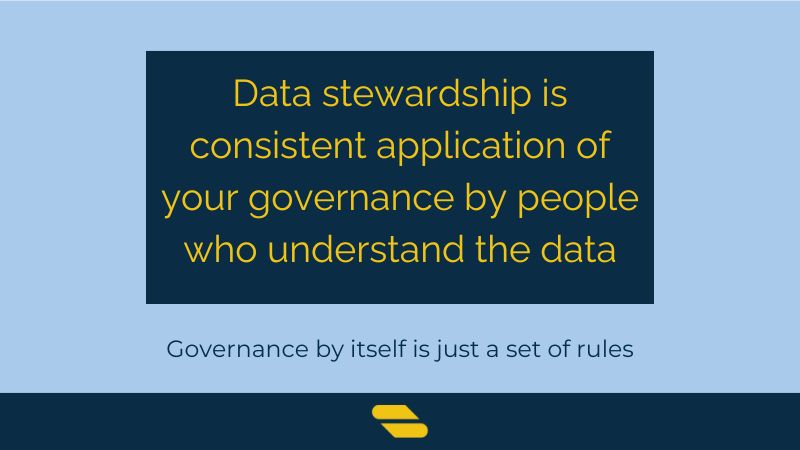
Governance is a set of rules, but stewardship is the human practice of enforcing them consistently, in the real systems where real work happens, by people who actually understand what the data is for and who depend on it.
This isn't some abstract concept … think of it as application of the governance concept. This means you need a few pillars in place:
Stewardship requires executive buy-in, not just a title. A data steward who can identify problems but can't mandate fixes is someone guaranteed to burn out and leave.
You either need a C-suite leader accountable for this, or at least consistently involved in supporting your primary point person. Accountability without authority is just a job nobody wants, which means you'll never enforce your data governance properly.
This requires cross-functional visibility. The person or team responsible for stewardship has to be able to see across departmental lines.
They need to be able to walk into a conversation with sales, finance, and marketing in the same room and say here's how your data connects, here's where it breaks, and here's what we need to agree on.
Could this be Revenue Operations or IT? Possibly! It depends on your organization's structure … and whether those teams are truly cross-functional and centralized.
It requires the courage to make decisions. “Of course it does, Andy,” you might be thinking.
Sure, it sounds silly to even say … but this is the one organizations underestimate most!
It's fear of failure that's stuck in what-ifs that delay decisions.
- What if we need this data field six months from now?
- What if we aren't sure?
If you take a data-first approach, you will 100% find data that isn't adding value.
Please hear this if nothing else: it's okay to remove a field.
I've said this dozens of times and it still surprises people. I'm not kidding, just because a field exists doesn't mean you're obligated to keep it!
You can always bring it back later if you truly need it because a business case surfaces that makes it actually valuable. But then, you'll know why … that's progress!
It requires continuity … not some three-month engagement. Stewardship is not a project with a start date and an end date. There is no go-live for this.
Business conditions change. New systems get added. Teams reorganize. Data that was reliable eighteen months ago can drift without anyone noticing until it shows up as a wrong number in a board deck or a customer complaint that could have been caught earlier.
That means regular check-ins, progress reports, and commitment to getting better month after month, year after year … just as your other core business processes do.
The Person in the Room Nobody Talks About
There's almost always someone who informally carries the weight of data stewardship without the title, authority, or recognition.
They're the one who gets called when the report looks wrong. Who knows that the account field on the opportunity isn't reliable because of how the bill-to and ship-to addresses get handled. Who built the Excel spreadsheet powering your pricing operation that the ERP secretly hasn't replaced.
This person is both an unsung hero and a massive business risk.
When institutional data knowledge lives in one person's head (or one person's spreadsheet), your organization's data reliability is one resignation or ill-timed vacation away from breaking down.
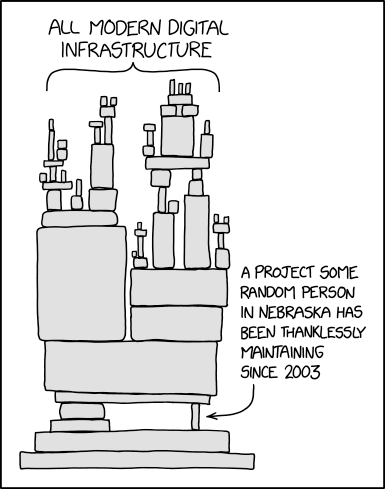
Stewardship is partly about formalizing what those people know, distributing that accountability more deliberately, and giving them the tools and authority to do the work properly rather than heroically. It tangibly reduces your risk.
Stewardship Becomes More Urgent Around AI
You knew it was coming: the AI link. Frankly, it's because the AI conversation's surfacing data stewardship problems that have existed for years … as I've said consistently, AI amplifies what it's built on!
A previous version of Precisely's Data Integrity Trends and Insights report states “despite 60% of organizations stating AI is a key influence on their data programs, only 12% report that their data is of sufficient quality and accessibility for effective AI implementation.”
A governance document doesn't care if your data is inconsistent. Neither does your AI agent, because it'll confidently produce answers … that you know are wrong. It needs a clear feedback loop to improve, but if what it's given to start with is wrong or lacking, it'll produce wrong or incomplete outputs…
…at scale.
Those getting real return from their AI investments aren't necessarily the ones with the most sophisticated models, but who did the less exciting work first: they figured out who owned their data, they established accountability for keeping it trustworthy, and they built the operational habits to sustain that over time on top of rock-solid architecture.
That's data stewardship.
It's not glamorous. It doesn't make for a great press release or shareholder headline. But it is the difference between AI that delivers and AI that gets shelved.
A Practical Starting Point For Your Data Stewardship
If you're reading this and thinking "we have this problem and I don't know where to start," here's the most honest advice I can give you: start with one outcome, not the whole organization.
Pick something specific: a forecast you don't trust, a churn report that's always a week late, a sales motion that depends on data nobody's sure is accurate.
Then, work backwards:
- What data does that outcome require?
- Who's responsible for each piece of it?
- Is it reliable enough to act on?
You'll find the gaps quickly, and once you do you're on the path to better-stewarding your data.
This is far better than starting with a master data management (MDM) project … those are built to perfect your data and governance, which is why they take years.
Don't try to boil the ocean.
MDM projects have their place, don't get me wrong … but good enough today, built on real accountability, beats perfect-on-paper every time.
Closing that gap is what our data architecture work does.