Most organizations are approaching AI the same way they approached every other technology initiative - there's a requirements phase, a build phase, a launch, and then the team moves on to the next project.
That model is familiar, but it's also wrong!
AI is not another system you deploy and walk away from. It is not a CRM or an ERP … you can't install it and then optimize when it's convenient to while leaving certain stones unturned.
AI agents behave far more like employees than applications, and organizations that fail to recognize this are the same ones wondering why their AI investments are stalled, shelved, or quietly creating risk.
(One note: I'm not advocating for anthropomorphizing your AI agents, but instead advocating for the approach to differ)
The AI mistake organizations keep making
When I talk to executives about AI, the conversation often starts with technology. Which model? Which platform? Which vendor?
It misses the point.
First, I'll sound like a broken record here ... data (which is fuel for your AI) is platform-agnostic and should be treated as such. If you're approaching this on a per-platform basis, you've already lost.
Second, AI doesn't fail because the technology is immature; building AI agents is largely a commodity. Anyone can connect a model to an API and generate responses!
The reason AI initiatives fail is because organizations treat them like static systems instead of living actors inside the business.
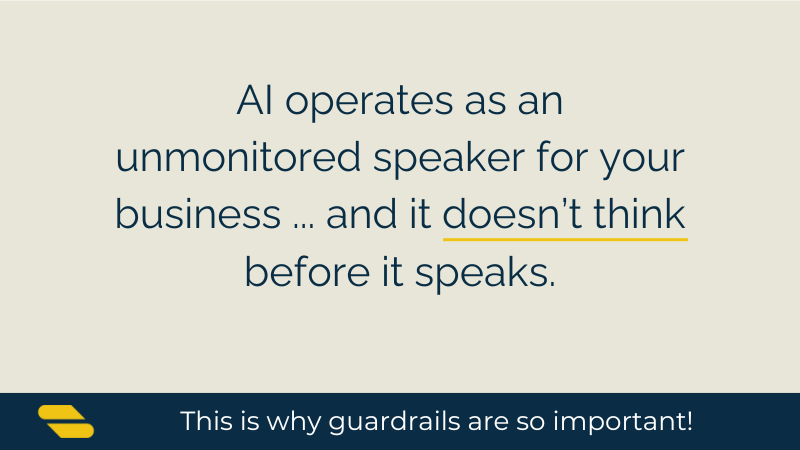
AI agents are unmonitored speakers for your business
Once an AI agent is deployed, it begins speaking on behalf of your organization. It interprets your data. It reflects your policies. It responds to customers and employees using the language and information you have grounded it on.
And unlike a human, it does not pause to think before it speaks.
That alone should change how leaders think about deployment.
An AI agent is effectively an unmonitored endpoint for your organization's knowledge, legal position, and customer information.
- It's answering questions when you are not there.
- It's creating impressions when leadership is not in the room.
Sound uncomfortable? It should!
Most have governance, training, and oversight processes for people because people represent the company. AI agents represent the company too, but many organizations deploy them without comparable controls.
The risk goes beyond hallucinations or incorrect answers - the real risk is misalignment.
An agent that makes sense in one department can contradict another department entirely.
That contradiction often shows up first in front of a customer, not internally.
Why AI behaves more like an employee than a platform
The most useful way I have found to explain agentic operations is to compare agents to employees.
When you hire someone, you don't just give them access to systems and hope for the best, right?
You onboard them. You train them. You monitor performance. You have regular reviews, such as 1-on-1s and performance reviews. You help your employee learn and adapt when needs change or when what they're providing drifts off-course from what's needed.
AI agents require this same approach.
- Onboarding an agent is grounding it in the right data and information architecture.
- Training is prompt refinement, feedback loops, and reinforcement over time.
- Performance management is observability, monitoring, and tuning.
- Governance (and stewardship) is defining what the agent can say, what it cannot say, and what happens when it crosses a line.
Ignoring these steps does not make the agent faster or cheaper. It makes it unpredictable.
Drift should be expected. It's not failure.
I see panic from leaders when an AI agent starts behaving differently than it did at launch. It's assumed to be broken.
It's usually not.
AI agents translate human language into mathematical patterns. You do not get the same answer twice … over time, as data changes and usage patterns evolve, behavior shifts. You don't get the same answer twice from a well-functioning agent, let alone one that's been operating in a live environment for months without tuning.
This drift is expected, and it's not the problem - it's a lack of visibility into what's driving this.
I like to use a golf analogy:
- Early on, the agent hits consistently in the fairway
- Over time, without training, it starts hitting into the rough on either side … not ideal, but a manageable mistake
- Eventually, it starts careening the ball deep into the woods, the pond, or out of bounds. A mistake that's painful.
Here's how it plays out in practice. Early on, the agent responds consistently and accurately. Without monitoring and periodic retraining, its understanding gradually diverges from what you intended. Small misalignments compound. Eventually, the agent isn't broken, but it's understanding things differently than it used to in ways that are invisible to you until a customer encounters them.
Let me stress this again: nothing is broken! The agent is simply learning differently than you anticipated.
The fix? It's not more rigorous testing before launch - it's building observability into the system from day one, and a lack of this is a common reason why AI pilots fail.
Observability for AI agents goes beyond knowing whether the system is online. PwC defines it as the practice of collecting data from each AI action to enable transparency and understandability; in other words, seeing not just what the agent is doing, but why. That means monitoring inputs, reasoning paths, and outputs together, so drift can be caught and corrected before it surfaces in front of customers or prospects.
In practice, this means watching more than the agent's responses. It means tracking how users are constructing their questions, how the agent is interpreting follow-ups, whether it's asking clarifying questions when it should, and whether the conversational patterns it's learning reflect what you actually want it to do.
Most organizations spot-check outputs after launch and call it monitoring. That's not enough!
Review rhythms need to be scheduled. Feedback loops need to be built in. Ownership of what happens when behavior drifts needs to be assigned before the agent goes live and not discovered when something goes wrong.
This is not a 60-day post-launch concern. For agents operating in live business environments, it's an ongoing operational function for as long as the agent is in the field - what we call agentic operations.
Why most AI proofs of concept never reach production
Why do so many AI pilots stall before becoming real, scalable capabilities? After all, CIO Dive reporting shows over 40% of them being scrapped.
It's because the operational scaffolding was never built:
- Outcomes weren't defined clearly enough.
- Data paths weren't laid in advance.
- Governance and observability were treated as post-launch concerns.
- And more often than not, the agent was deployed inside a single department without the cross-functional alignment the rest of the organization needed.
I've written about each of these failure points in my article on why AI pilots keep failing, including what to actually do about them before you go live.
AI readiness can't be deployed in a vacuum
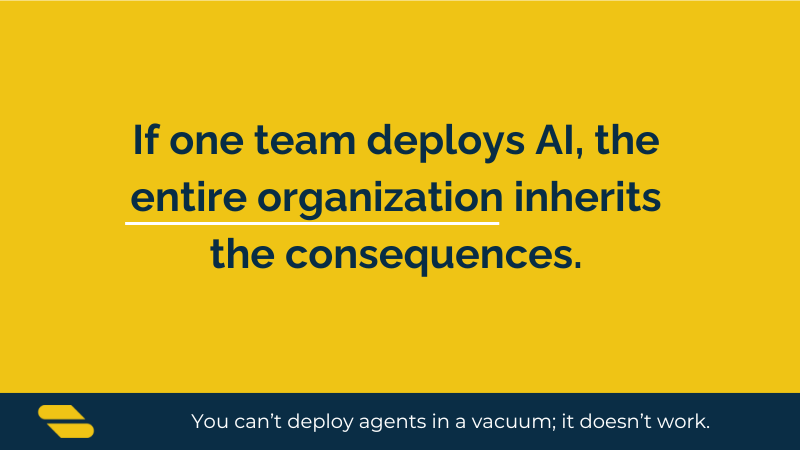
One department launches an agent that makes perfect sense to them, but contradicts another team - think customer service going live with a chatbot but that offers different answers than what finance or legal might downstream.
AI is truly cross-functional because it's speaking for your entire organization, not just for a single department. So your readiness isn't about checking boxes, it's about alignment.
Every function that will be affected by an agent's inputs or outputs needs a voice before it goes live.
If one team deploys AI, the entire organization inherits the consequences.
What leaders should do differently about organizational AI Readiness
- First, just like any other initiative, start with your critical outcomes - not tools.
- Architect your data and information before layering in models.
- Invest in resources for better observation and governance alongside licenses and development.
And most importantly, accept AI requires ongoing care like a full-time employee vs. a one-time delivery like a technology.
You'd never hire an employee and fail to check their work; don't deploy an AI agent and walk away.
Get AI readiness consulting help from a trusted source that's doing this today for companies just like you. We're ready when you are.