We analyzed 187,000+ job postings to find out why so many headlines keep showing AI initiatives fail. One common reason: racing ahead without data foundations.
American businesses are in the grip of an AI crisis most won't admit, and they're approaching it the wrong way. The result? Well, we're already seeing it, with headlines showing so many failed AI pilots and companies pulling back from their investments.
MIT's analysis of 300+ corporate AI deployments found that "95% of organizations are getting zero return."
The S&P Global reports that 42% of companies scrapped most of their AI initiatives in 2025, more than double the 17% abandonment rate from just a year earlier.
A lot of highly reputable sources are all saying the same thing: AI in its current form is not working for the majority of businesses.
At DoubleTrack, we have a theory on why this might be. The culprit isn't the AI itself, it's the missing foundation beneath it. Namely: great, well structured data. We are seeing a lot of businesses run headlong into AI without getting their house in order first and the results lead to a lot of wasted time and the incorrect assumption that AI just isn't that useful.
We're currently seeing the equivalent of businesses investing in Formula 1 cars and proceeding to fuel the machine with cooking oil.
We decided to test that theory, so we analyzed job posting data across the United States to see whether companies are prioritizing hiring AI talent over the data infrastructure roles needed to support them.
The results confirmed our suspicions.
AI roles outnumber data infrastructure positions by 46% (a gap of nearly 35,000 jobs) with AI specialists commanding salaries $15,680 higher on average. Businesses aren't just neglecting their data foundations, they're actively outbidding themselves to hire people who won't be able to do their jobs properly.
Click to jump to a section: Data Gap | National research | Industry breakdown | State-by-state research | Conclusions | Methodology
According to RAND Corporation research, over 80% of AI projects fail ... more than double the failure rate of non-AI technology projects.
This finding comes from RAND's analysis of enterprise AI initiatives and is one of the most widely cited statistics in discussions of AI adoption challenges.
The RAND finding at a glance:
This pattern is consistent with the other major research from S&P Global and MIT's analysis linked in the intro: companies aren't nearly as ready as they think.
When Gartner surveyed data management leaders in 2024, they found that 63% of organizations lack confidence in their data management practices for AI. By 2026, Gartner predicts, organizations will abandon 60% of AI projects unsupported by AI-ready data.
The pattern is consistent across every major research study: AI initiatives don't fail because the models aren't sophisticated enough, they fail because the data feeding those models is incomplete, poorly structured, or downright inaccessible.
Informatica's 2025 CDO Insights survey identified the top obstacles to AI success: data quality and readiness (43%), lack of technical maturity (43%), and shortage of skills and data literacy (35%). And our dirty data research shows the cost: over $600B annually.
The technical infrastructure required to support AI - such as data pipelines, governance frameworks, quality controls, integration systems - demands specialized expertise. Yet businesses are hiring AI engineers while leaving database engineer, data platform engineer, and data quality analyst positions unfilled.
This creates a predictable cycle. Companies invest heavily in AI talent, only to discover their CRM data is incomplete, their databases are poorly configured, or their data governance is non-existent. AI projects stall. Models produce unreliable outputs. The expensive AI specialists spend months cleaning data, work that should have been handled by a properly staffed data infrastructure team.
Our analysis of US job market data reveals how widespread this pattern has become, and it lines up closely with what we found when we approached the same question from a different angle: state-by-state and metro-by-metro, adoption is outpacing local AI talent supply in almost exactly the same places.
Related: AI Readiness consulting that tackles the right problems.
Across the United States, employers have posted 111,296 AI and machine learning positions compared to just 76,271 data infrastructure roles - a gap of nearly 46%.
AI specialists are earning an average of $141,934, while data infrastructure professionals make $126,254 - while neither is what you'd call a bad salary, it's telling that AI roles are being given $15,000 more on average.
The disparity suggests companies are racing to implement AI capabilities without ensuring they have the underlying data quality, governance, and infrastructure to make those investments worthwhile.
The AI-first hiring pattern isn't uniform across industries.
Some sectors show concerning imbalances, while others demonstrate a more measured approach.

Sales organizations lead the imbalance. Sales teams are posting 232% more AI positions than data roles (1,777 versus 536), betting heavily on AI-powered forecasting and lead scoring without corresponding investment in CRM data quality. This is particularly concerning given that sales data is notoriously messy - reps update records inconsistently, deals sit in wrong stages, and contact information decays rapidly.
Without clean pipeline data, AI recommendations become data noise salespeople quickly learn to ignore, perhaps why Gong's 2026 research shows most sales teams that have adopted AI aren't showing results.
Legal shows the second-highest imbalance. Law firms and legal departments are hiring AI specialists at 181% higher rates than data infrastructure professionals - 351 AI roles versus just 125 data positions. The legal industry's rush toward AI-powered document review and contract analysis is outpacing investment in the data governance systems those tools require. In a sector where accuracy isn't optional, this is a significant blind spot.
Engineering follows the pattern. Engineering departments show a 168% imbalance (10,915 AI roles versus 4,070 data positions). The appetite for AI-driven optimization and predictive maintenance is outstripping the infrastructure work needed to feed those systems reliable data.
Marketing is closer to balanced, but still off. Marketing teams demonstrate a 54% gap (1,270 versus 826) - the smallest imbalance among the AI-heavy sectors, but still indicative of the broader trend.
Finance prioritizes foundations. The financial sector shows a 240% higher rate of data infrastructure hiring compared to AI roles - 2,948 data positions versus 868 AI roles. Years of regulatory scrutiny around data governance, accuracy requirements, and audit trails have forced financial institutions to build robust data foundations before experimenting with AI. The compliance burden that many view as a hindrance may actually be protecting these organizations from the failures plaguing less regulated industries.
Healthcare follows the same pattern. Healthcare organizations are hiring data infrastructure professionals at 164% higher rates than AI specialists (1,635 versus 619). HIPAA requirements, clinical data standards, and the life-or-death stakes of medical accuracy have created a culture where data quality isn't an afterthought. These organizations understand that an AI model is only as reliable as the data it's trained on.
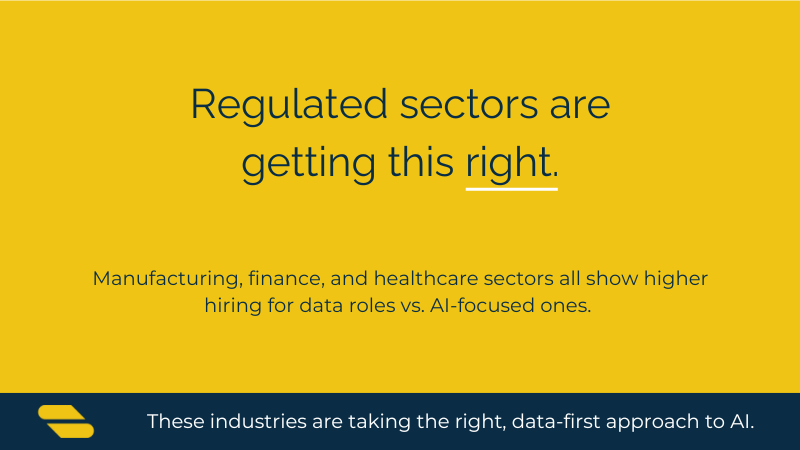
Manufacturing shows the widest infrastructure-first gap. The manufacturing sector is hiring data infrastructure professionals at 273% higher rates than AI specialists (123 versus 33). This reflects an industry where poor data quality has immediate, tangible consequences - production line failures, quality control issues, wasted materials. Manufacturers have learned the hard way that you can't optimize what you can't measure accurately.
Sectors with high failure costs and regulatory oversight are investing in data infrastructure first. Sectors driven more by competitive pressure without the same level of oversight seem to be skipping the foundations entirely.
Finance, healthcare, and manufacturing aren't anti-AI but are approaching this methodically and in the right order - they understand that AI implementations built on shaky data foundations will fail, and failure in their industries is expensive, regulated, or both.
Sales, legal, and engineering are learning this lesson the hard way, likely contributing disproportionately to the 80% of AI projects that never deliver.
The AI hiring imbalance varies significantly by location, with some states showing particularly dramatic gaps.
Mississippi leads the national imbalance at 264%, posting 626 AI positions against just 172 data infrastructure roles. Missouri (179%), Kansas (176%), and Montana (175%) follow close behind. A cluster of midwestern and southern states - Iowa, Louisiana, Arkansas, Kentucky, Nebraska - all show imbalances above 100%.
What's driving this? These states have smaller, less mature tech sectors and are likely playing catch-up. Without established technology leadership who've lived through previous hype cycles, there's less institutional knowledge about the importance of data foundations.
The pressure to modernize and attract tech investment may be pushing these regions to hire for the flashy roles first, skipping the unsexy infrastructure work that makes AI actually function.
California shows a 37% imbalance (10,417 AI roles versus 7,587 data positions). New York sits at 38% (3,448 versus 2,490), Massachusetts at 20% (2,328 versus 1,944). Still imbalanced, but nowhere near the extremes seen in less tech-mature states.
These markets have deeper talent pools, more experienced CTOs and data leaders, and companies that have already learned expensive lessons about building on bad data. They're not immune to the AI hiring rush - the imbalance still favors AI at 46% across the USA - but there's a moderating effect.
When you've got engineers who remember the big data hype cycle of the 2010s, or the machine learning pilot projects that went nowhere in 2018, you're less likely to repeat the same mistakes.
| State | AI Jobs | Data Jobs | % Higher |
|---|---|---|---|
| California | 10,417 | 7,587 | 37% |
| Virginia | 4,130 | 2,015 | 105% |
| Texas | 3,641 | 3,742 | -3% |
| New York | 3,448 | 2,490 | 38% |
| Florida | 2,655 | 2,115 | 26% |
| Massachusetts | 2,328 | 1,944 | 20% |
| Ohio | 1,943 | 1,737 | 12% |
| Georgia | 1,905 | 1,932 | -1% |
| District of Columbia | 1,852 | 2,098 | -12% |
| Washington | 1,852 | 2,098 | -12% |
| Pennsylvania | 1,807 | 1,832 | -1% |
| Illinois | 1,801 | 1,001 | 80% |
| North Carolina | 1,628 | 730 | 123% |
| Colorado | 1,454 | 1,712 | -15% |
| Michigan | 1,420 | 1,543 | -8% |
| New Jersey | 1,411 | 863 | 63% |
| Maryland | 1,300 | 2,135 | -39% |
| Tennessee | 1,270 | 1,449 | -12% |
| Arizona | 1,265 | 1,525 | -17% |
| Missouri | 1,031 | 369 | 179% |
| Connecticut | 986 | 370 | 166% |
| Nevada | 964 | 1,277 | -25% |
| Indiana | 952 | 1,389 | -31% |
| Oregon | 904 | 1,318 | -31% |
| Minnesota | 887 | 457 | 94% |
| Utah | 878 | 380 | 131% |
| Wisconsin | 790 | 404 | 96% |
| Iowa | 766 | 301 | 154% |
| Alabama | 738 | 397 | 86% |
| Kentucky | 672 | 294 | 129% |
| Oklahoma | 653 | 1,222 | -47% |
| Kansas | 648 | 235 | 176% |
| Arkansas | 642 | 278 | 131% |
| South Carolina | 635 | 302 | 110% |
| Mississippi | 626 | 172 | 264% |
| Nebraska | 619 | 284 | 118% |
| Idaho | 577 | 251 | 130% |
| Louisiana | 548 | 218 | 151% |
| Vermont | 515 | 1,192 | -57% |
| New Mexico | 511 | 263 | 94% |
| New Hampshire | 449 | 194 | 131% |
| Rhode Island | 440 | 172 | 156% |
| Delaware | 439 | 200 | 120% |
| West Virginia | 394 | 165 | 139% |
| Maine | 386 | 159 | 143% |
| South Dakota | 385 | 149 | 158% |
| North Dakota | 374 | 141 | 165% |
| Montana | 371 | 135 | 175% |
| Alaska | 354 | 143 | 148% |
| Hawaii | 6 | 2 | 200% |
| Wyoming | 2 | 6 | -67% |
Related: Tech hubs know the importance of getting quote-to-cash right, too
A handful of states are actually hiring more data infrastructure roles than AI specialists - 16 states out of a possible 51 (including DC) - are showing negative imbalances, meaning they're prioritizing data roles.
Some of this may be sector-driven. Maryland's proximity to federal government contracts - where data security and compliance are paramount, likely influences hiring patterns. Vermont and Oregon's smaller tech scenes may be more pragmatic about building foundations before chasing trends.
Pennsylvania, Georgia, and Texas sit almost perfectly balanced, with differences of just 1-3%. These states have diverse economies with both hype-driven startups and established enterprises that understand infrastructure requirements.
The pattern suggests technology maturity acts as a buffer against hype-driven hiring. States with established tech ecosystems, experienced leadership, and exposure to previous cycles of overpromise and underdelivery are showing more restraint.
This doesn't mean Mississippi or Kansas are doomed to fail, but it does suggest their AI investments carry higher risk. Without corresponding investment in data infrastructure, many of those 626 AI roles in Mississippi may end up doing exactly what the MIT research described: delivering zero measurable impact.
The conversation around AI has shifted. Twelve months ago, the fear was being left behind - missing the AI wave while competitors surged ahead. Today, the fear is whether any of this investment will pay off at all.
Talk of an "AI bubble" is no longer confined to skeptics and contrarians. When MIT reports that 95% of generative AI pilots deliver zero measurable profit impact, and S&P Global shows abandonment rates jumping from 17% to 42% in a single year, the question stops being 'are we moving fast enough?' and starts being 'are we building on solid ground?'
The data in this report suggests that for many businesses, the answer is no.
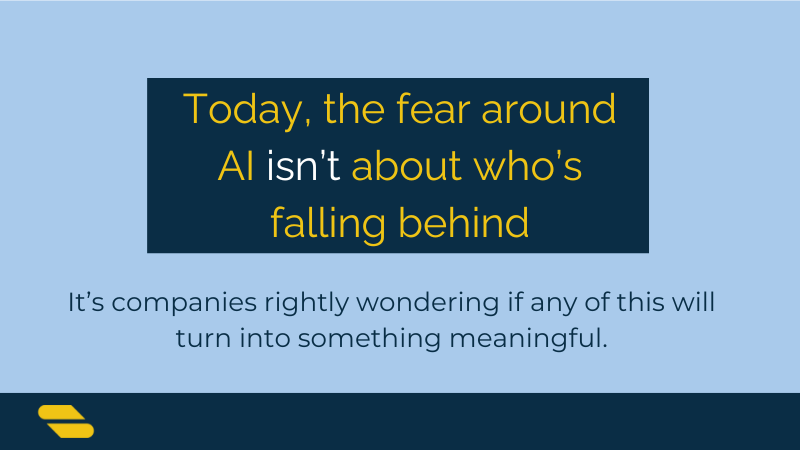
But here's the thing: this isn't a case against AI. It's a case against doing AI badly. The sectors getting it right (finance, healthcare, manufacturing) aren't avoiding AI. They're sequencing it correctly. They're building the data infrastructure first, then layering AI capabilities on top. They're hiring the mechanics before buying the robots.
The businesses most at risk right now aren't the ones moving slowly on AI. They're the ones who've hired aggressively for AI roles without corresponding investment in data quality, governance, and infrastructure. They're sitting on expensive talent that can't deliver because the foundations aren't there.
When the pressure comes to show ROI (and it will) these organizations will face a choice: go back and do the infrastructure work they skipped, or join the 42% abandoning their initiatives entirely.
For companies still early in their AI journey, the path forward is clear. Audit your data infrastructure before expanding your AI team. Understand whether your CRM data is actually reliable, whether your databases are properly configured, whether your data governance can support the AI use cases you're chasing. The unglamorous work of data quality and pipeline management isn't optional, it's prerequisite.
For companies already deep into AI hiring, the question is harder. But the evidence suggests that pausing to invest in data infrastructure isn't a step backward, it's the only way to make your existing AI investment pay off.
The AI bubble, if it bursts, won't punish every company equally. It will punish the ones who treated AI as a standalone initiative rather than a capability built on data foundations. The robots are only as good as the mechanics who keep them running.
RAND Corporation research found that over 80% of AI projects fail, which is more than double the approximately 40% failure rate of non-AI technology projects. This makes AI initiatives significantly riskier than comparable technology investments when organizations lack the data infrastructure to support them.
The majority of AI projects fail not because the technology is inadequate, but because the data feeding those models is incomplete, poorly structured, or inaccessible. Research from Gartner, RAND, MIT, and S&P Global consistently identifies data readiness (which includes data quality, governance frameworks, and infrastructure) as the primary obstacle to AI success.
Yes. DoubleTrack's analysis of 187,567 U.S. job postings found that companies are posting 46% more AI and machine learning roles than data infrastructure positions. AI specialists are also commanding salaries $15,680 higher on average than data infrastructure professionals, suggesting organizations are actively prioritizing AI capability over the foundational work that makes AI viable.
Finance, healthcare, and manufacturing show the strongest data-first hiring patterns. Financial services firms post 240% more data infrastructure roles than AI roles. Healthcare organizations post 164% more. These regulated industries have been forced by compliance requirements to build data governance before deploying AI, and the discipline appears to be protecting them from the failure rates plaguing less regulated sectors.
Before expanding AI teams or deploying AI platforms, organizations should audit their data infrastructure: Is CRM data complete and reliable? Are databases properly configured? Is there clear data governance? The unsexy architecture focus on data pipelines, quality controls, and governance frameworks is a prerequisite to AI delivering value instead of having your pilots stall.
This analysis examined 187,567 job postings collected via the Adzuna API in November 2025.
Forty total job roles were analyzed and positions were categorized as either "AI/ML" roles (including machine learning engineers, AI scientists, prompt engineers, and related positions) or "Data Infrastructure" roles (including database engineers, data platform engineers, data quality specialists, and related positions), with twenty roles for each category.
Salary figures represent averages calculated from postings that included compensation information. State-level and sector-level breakdowns were determined using employer-provided location and industry categorization data.

Architecture. Before activation.