Here's how I look at it: every company has data, and most have some information … but very few get to insights, and almost no one gets to true knowledge.
That's the pyramid our data-first approach is built on: Data → Information → Insight → Knowledge.
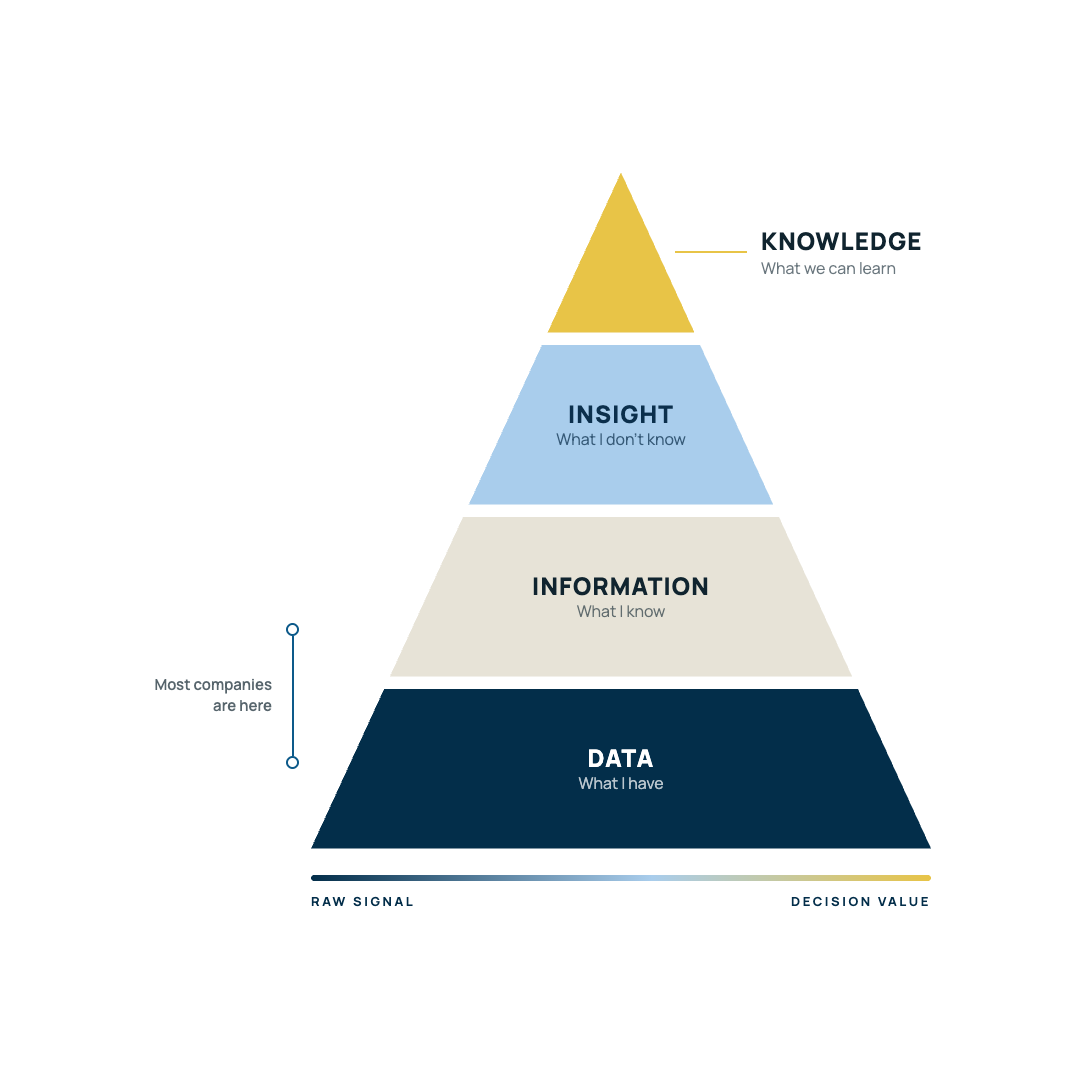
Too many organizations get stuck at the bottom of it, usually without realizing they're stuck at all because nobody goes “I don’t have the data.”
Picture this: you’re trying to figure out why sales dipped last month, so you pull in Quotes and support marketing data. But as you bounce between reports, your gut tells you something’s not right … and in fact, after an hour, you’re no closer to an answer than when you started.
Why? Data chaos.
What I Mean by "Data Chaos"
Let me be precise about what it actually means, because it's not the same thing as bad data or dirty data.
Data chaos is when you have too much unhelpful data.
It represents your organization having so much data, spread across so many systems, with no shared framework for understanding what any of it means or what it's for, that nobody can tell which numbers to trust. You can have perfectly clean data and still suffer from data chaos (though the cost of dirty data itself is something you shouldn’t ignore, either).
If it seems like I’m being pedantic, let me be more clear: the fix for both are different, so knowing the root cause matters greater. Dirty data gets cleaned, from the underlying architecture to the records themselves. Data chaos gets organized and what’s wasteful needs to be removed, whether it’s architecture, process, integrations, or data sources.
The problem is too many companies try to fix the problem by … adding more data. And as the pyramid shows, that’s not getting you anywhere (except more in data debt!).
The Trap: Data Rich, Information Poor
I'll give you an example. About a year ago, a manufacturing client came to me asking to pull order history into their enterprise CRM. Made sense, straightforward request … until they wanted more.
A pull expanded to include all from service history to bills of materials to account data. All of it, in one place … sounds nice, right? A one-stop shop, all buttoned-up. And it did attack one symptom, in that it pulled scattered data together … but that data was still unhelpful.
“Closed” in the ERP didn’t match what “closed” meant in the field service tool their techs used; those two definitions alone led to plenty of re-work. And that’s data chaos!
They were data rich, but information poor: all the data in their business was there, but much of it wasn’t giving them anything that would lead to something useful (or they could act upon). Mental friction is still friction that slows you down, and it’s the silent killer of all businesses.
The fix for this client was their data needed to be defined consistently across the systems it already lived in. Technology - whether it’s adding a new platform or consolidating what you have - can’t fix data, which is platform-agnostic.
An Additional Human Cost: Stress
Data chaos weighs people down.
Executives look at years of collected data and think, “I should be able to answer this question.” But the answer isn’t there. That gap creates stress, erodes trust in systems, and frustrates teams.
The way out isn’t to “boil the ocean.” It’s to start small. One win leads to another: a simple insight that improves retention or a clearer trend that shapes customer strategy.
Those wins stack. Suddenly, you’re building real knowledge!
It’s tempting to dive in and start optimizing for these individual wins, and you do need to show wins when you’re tackling your data - and truly, your business - strategy challenge.
How We Sort Through Data Chaos
Once you're looking at a real mess of data like that, you need a way to sort it that doesn't take a three-year governance project to execute. I’m not joking, I’ve seen global consultancies posture a multi-year Master Data Management (MDM) plan with a $3 million price tag as the only way forward.
I’m sorry, but it’s not even close; this should take weeks, not years.
To prove it, that’s where our 844 approach comes in: we bucket every company's data into eight categories, and score each piece against four tests (what’s relevant, reliable, revealing, reusable?) to figure out what's actually worth building on. Once your data’s ready, then we approach the four Ps of AI readiness to build agentically upon the right foundation.
But for this article, what matters is what that sorting is for: your mechanism that turns an undifferentiated pile of data into something you can actually climb the pyramid with.
A Data-First Framework
This is why we bring a data-first framework into every engagement. It's quick, it's agile, and it grows with the business. Every problem we look at, we run through the same lens:
- What's the data? Where’s it coming from, and why?
- What's the information? What do we already know, reliably, today?
- What insights are missing? What do we not know yet, and what are questions the data could answer if it were organized to answer them?
- What knowledge can we gain? You’d be shocked how many blank stares I get when I ask this, but it uncovers a lot of assumptions.
Climbing from data to information is mostly mechanical, a la reporting, dashboards, etc. etc. I’d argue about 80% of companies are in the information stage.
The harder, more valuable climb is from information to insight, and from insight to real knowledge: the kind that changes a decision and with confidence. If you want to get there, our data services are the starting point.
FAQ
What is data chaos? Data chaos is what happens when an organization has data spread across many systems with no shared framework for what any of it means. It's different from "dirty data" because you can have technically accurate records and still be in data chaos if nobody agrees on what those records are for.
What causes data chaos in a business? Usually, it's growth outpacing structure: new systems get added over time, each with its own definitions and conventions, and nobody goes back to reconcile them. The instinct to fix this by consolidating everything into one platform often makes it worse, because it centralizes the chaos instead of resolving the underlying definitions.
How do you fix data chaos? Sort what you have into consistent categories, test each piece against clear standards for whether it's actually useful, and build a shared framework for what your data means before you try to consolidate or automate anything on top of it. Our Four Rs and Eight Buckets framework is the starting point.
That's where data architecture comes in.