I talk to a lot of executives who say some version of the same thing:
“We're investing in AI.” “We're piloting it for quote creation.”
Or more commonly, “We're under pressure from the board to do something with AI.”
And yet, when the conversation turns to revenue impact, any confidence quickly fades…
…not because AI doesn't work, but because most organizations skip the steps that turn AI into something operationally meaningful. AI doesn't thrive without Information Architecture (IA), which is how your data is defined and structured across your systems. This feeds any AI initiative, and most orgs I've seen fail on this front.
Want proof?
- Multiple reports market intent to cut back on AI initiatives
- Gong's analysis showed a massive gap for sales teams using AI while quota attainment fell
- Dirty data accounts for $600B+ in cost for US business alone. Guess what AI does with this? Yep, makes it worse.
In a recent webinar I co-hosted with DealHub's Eyal Orgil and our own Caleb Rule, we laid this out plainly: AI adoption is accelerating, but results are declining.
Not because teams lack ambition, but because AI readiness is missing.
From what I've seen over the last several years, there are three gates every organization must pass. Miss any one of them, and AI becomes faster chaos instead of better outcomes.
Gate 1: Signal Comes Before Scale - Data Architecture and The Four Rs of Data
Most revenue organizations aren't lacking for data - they're overwhelmed by it.
Open your CRM. Look at an opportunity record. Ask yourself how many fields are unused, unclear, or actively ignored. Then ask where those fields feed downstream and what noise they create across quoting, forecasting, and revenue reporting.
This is what I mean when I say we are information-rich and knowledge-poor.
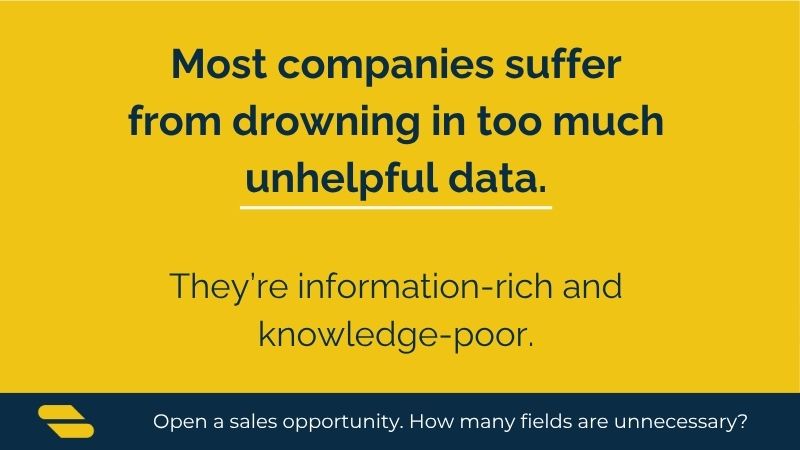
AI does not create signal. It amplifies whatever already exists. When the underlying data is irrelevant, unreliable, or poorly understood, AI simply accelerates the mess. AI amplifies everything, including chaos.
That is why data architecture matters, but not in the way most people think.
Data is not a system or a platform. It is not what happens to be visible on a screen or stored in a database. Data architecture is about planning for insights and knowledge, not just reports and dashboards. Outcomes have to come before technologies.
To make this practical, I use a simple filter called the Four Rs test. Every data element should be:
- Relevant
- Revealing
- Reliable
- Reusable
If it doesn't pass at least three of those four, it's friction.
This is not theoretical. Research consistently shows that poor data quality carries massive financial cost. Forrester estimates it costs organizations millions annually through inefficiency and missed opportunity. AI trained on low-signal data does not become insightful - it becomes confidently wrong.
In practice, I see the same four failure patterns repeat across organizations:
Garbage gets amplified. AI doesn't know what's real. If your pipeline data is inconsistent, your forecasts will be too. AI makes bad data louder.
Unclear relationships mean weak insights. AI looks for patterns, but patterns only exist if your data relationships do. If your CRM can't tell how customers, products, and orders actually relate, AI ends up analyzing isolated fragments - and likely pulling data that doesn't match from other systems, like your ERP or data lake. And this is why....
Siloed systems hide the truth. When every system speaks its own language (sales data here, service data there, marketing data trapped somewhere else) AI is blind to the bigger picture.
Poor observability = no improvement. AI learns by feedback. It is going to drift and get things wrong - this is normal! But if no one owns data quality or defines what "good" looks like, the model has no way to course-correct. And without a clear audit trail that helps your team quickly see why the AI drifting, you're stuck guessing and letting your agent learn faster from the wrong things.
The good news? You don't need a three-year governance program to fix this. You do need to be honest about what data deserves to exist.
Gate 2: AI Needs Guardrails To “Raise” It Well
Even organizations that improve signal often stumble next because they treat AI like a fully formed adult.
During the webinar, Eyal used a metaphor that stuck with me: AI is like a teenager.
I love this thought (which pairs nicely with what I've previously said about treating AI like an employee).
It is powerful, fast-learning, and capable, but without structure and boundaries, it'll make expensive mistakes and you're often worried about what might come next.
This distinction matters most in your quote-to-cash processes.
In marketing or research, a little inconsistency might be tolerable. In pricing, contracts, and revenue recognition, it is not. Contrasting AI expectations with reality: hallucinations, bias, governance gaps, privacy concerns, and audit requirements all surface quickly when guardrails are missing.
This is not hypothetical. Public companies cannot explain pricing decisions to auditors by saying “the model decided.” Revenue systems demand consistency, standardization, and auditability. AI that bypasses those constraints will stall, no matter how impressive the demo looks.
Governance is not anti-innovation. It is what allows innovation to scale safely.
If AI is a teenager, governance is not parenting style. It is the house rules that keep revenue defensible.
Gate 3: Workflows Prove AI Earns Its Keep In Quote To Cash
The final gate is where AI either proves its value or quietly gets shelved. Spoiler: many haven't shown true business value, one of the drivers of that now-infamous "95%" statistics from MIT about generative AI pilots (though that number deserves a caveat, since it measured pilots at a single point in time rather than tracking outcomes over the long run).
AI delivers revenue impact when it is embedded inside workflows that already reflect how the business actually operates.
Your quote-to-cash system is one of the clearest examples of this.
Modern revenue engines must account for five realities, as my colleague Eyal noted:
- Sales channels are no longer singular Direct, indirect, self-service, and product-led motions all coexist.
- Solution portfolios are dynamic Products, bundles, dependencies, and prerequisites constantly change.
- Pricing models are mixed Recurring, one-time, consumption-based, and hybrid models live side by side.
- Buyer demands have shifted Personalization and self-service are expected, not optional.
- Contractual exposure must be visible and managed Across regions, deal sizes, and regulatory environments.
This is why quote-to-revenue works as an AI use case. It does not tolerate improvisation.
A critical reminder here: AI is not just about scalability. It is about consistency, standardization, and auditability.
When AI is applied inside governed quote-to-revenue workflows, it can support real outcomes:
- Pricing optimization informed by historical deals without bypassing approvals
- Revenue insights surfaced through governed queries instead of static dashboards
- Legal risk identified through contract analysis defined by legal teams
- Buyer self-service enabled without sacrificing control
These are not experiments. They are operational capabilities built on readiness.
What I Want You to Take Away
Before layering AI onto your revenue systems (think forecasting, quoting, agent automation, or anything related), ask these three questions:
- Do we have a single, accurate definition of a customer that every system agrees on?
- Are product, pricing, and opportunity data synchronized across our CRM, ERP, and billing platforms?
- Can we trace how data moves from first touch through to revenue without manual reconciliation?
If any of those answers require a spreadsheet, a conversation with IT, or an honest "I'm not sure" then you have an architecture gap that AI will expose, not fix.
This is your sign to stop and re-evaluate your AI readiness.
AI adoption is not the problem. These tools are commoditized. But organizational impatience? That absolutely is a massive hindrance.
Too many organizations rush to scale before they have signal. They deploy intelligence before defining guardrails. They expect AI to fix workflows they never truly designed.
The companies seeing revenue impact are not more advanced. They are more disciplined.
They treat data architecture as a revenue prerequisite, not an IT project. They raise AI with structure and oversight. They embed AI inside quote-to-revenue workflows where consistency and auditability already exist.
Do that, and AI does not just look impressive.
It moves the number that actually matters.