The proof of concept worked. The demo impressed the right people. Someone signed a contract.
And then, somewhere between "this is promising" and "this is operational," the project stopped moving.
I see this constantly, and so does the IDC. Their research, conducted with Lenovo across hundreds of organizations, found that 88% of AI proofs of concept never make it to production. For every 33 pilots a company launches, only four graduate to real deployment.
IDC's own conclusion is blunt: the gap between proof-of-concept and production reflects "the low level of organizational readiness in terms of data, processes, and IT infrastructure."
I want to be honest with you: I don't have a 100% success rate getting AI pilots to production either, even when I have them pass our four Ps.
Anyone who claims they do is either exaggerating or redefining success. But after three decades in enterprise technology, I've seen enough failed deployments to know exactly where they break down ... and it's almost never the technology.
It's especially true with AI; building AI agents today is a commodity. You can plug into Claude, ChatGPT, or a dozen other platforms and have something running in days. That part is solved.
The problem is everything that has to exist around the agent before it can operate in the real world. And most organizations don't find out what's missing until production forces it into the open.
Here's what I've learned about where pilots stall and the four gates every organization needs to pass before they go live.
AI Pilots Fail Without Defined Outcomes
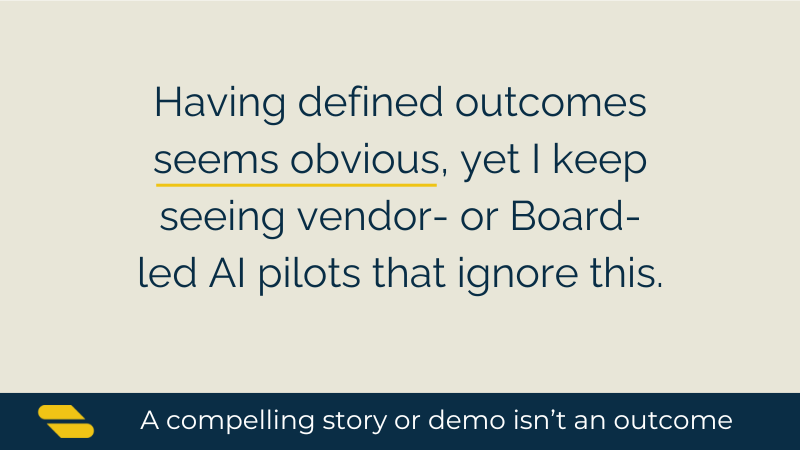
The most common failure mode I see isn't technical in nature: it's that pilots start with "let's try AI" instead of "here's the specific decision we're trying to improve."
Those are not the same thing.
A use case describes what AI might do. An outcome is the business decision it supports: faster quote cycles, better service resolution rates, more accurate forecasting.
If you can't name the decision, you're not ready to automate it. You end up building something technically impressive with no way to measure whether it's working, and no way to defend the investment when the budget conversation comes around.
This sounds obvious. It almost never happens in practice. Most pilots get initiated because a vendor told a compelling story, or because a board asked "what are we doing with AI?" Neither of those is an outcome.
When I talk to executives about this, my first question is always: are you being led by a vendor who's telling you a story about what their technology can do? Or are you being led by a genuine need to improve something specific in your business?
You need to be crystal clear on what you want the agent to do, and equally clear on what you don't want it to do. Find an advisor who will listen to that answer and help you build from it, not one who walked in the door already knowing which technology they're going to sell you.
Start with the outcome. If you can't name it, you're not ready.
AI Pilots Fail Without Clean End-To-End Data Paths
Pilots tolerate messy data. Someone cleans inputs by hand. Edge cases get manually corrected. The demo runs cleanly because you controlled what went in.
Production doesn't have that luxury. Once an AI agent goes live, it's drawing from your actual data, with all its contradictions, gaps, and competing definitions, in real time.
The question isn't just whether your data is clean. It's whether it's architected. Which system is the source of truth? How are objects defined across departments? If you ask ten people in your organization to define "customer," do you get ten different answers?
Because if you do, your agent will reflect that fragmentation to whoever's on the other end of the conversation.
You can have the cleanest dataset in the world, but if you don't know which system is authoritative or how data objects relate across departments, the agent will behave unpredictably at scale. The pilot looked impressive because you chose the inputs.
Production exposes everything you didn't account for.
This is also where prompt construction matters more than most people realize. How are you grounding the agent? How should it handle queries it can't answer confidently? What happens when a user asks something outside the guardrails you've set?
These decisions have to be made before launch, not discovered through live customer interactions after the fact.
Related: data architecture consulting that fixes the underlying issues
AI Pilots Fail Without Cross-Functional Alignment In Place Before Anything Goes Live
This is the gate most organizations skip entirely because it's the slowest and least exciting part of the process. It's also the one that causes the most visible damage when it's missing.
Here's the pattern I see repeatedly: one department builds a pilot. It makes perfect sense for them. They launch it. Then another team looks at the output and says "that's not how we define that metric." Legal flags a response. Finance disputes the logic. A customer gets an answer nobody anticipated and stops calling.
AI agents don't respect org charts. If an agent touches customers, contracts, pricing, or policy, it's speaking for the entire organization, not just the team that deployed it. Deploying in a vacuum means the outputs make sense for the department that built it, but contradict someone else in the organization. And when a customer finds out before you do, you're in reactive mode.
That reactive moment is usually what kills the initiative. The first instinct when something goes wrong with AI is to pull back. But pulling back is how you kill the investment. You have to push into it: understand what happened, why the agent responded the way it did, and fix it. The organizations that treat every unexpected output as a reason to shut things down are the ones that never get to production.
The alignment conversation has to happen before launch.
Not as a bureaucratic approval process, but as a genuine cross-functional review of inputs and outputs. Legal, finance, service, sales: anyone whose domain the agent touches needs a voice before it goes live. It's slower. It's worth it.
AI Pilots Fail Without Clear, Enforceable Governance And Observability In Place
Here's something I've found surprises people most: language models don't return the same answer twice.
They interpret everything as a mathematical formula. They adapt. Behavior shifts over time as usage patterns evolve and context changes.
This isn't a flaw. It's how these systems work. I like to use a baseball analogy: early on, the agent is consistently hitting between first and second base. You let it go for a while without monitoring and tuning, and all of a sudden it's firing line drives between first and third, with high confidence but a wider range.
Then it's between third and the dugout ... now it's hitting pop flies to the outfield, and eventually foul balls. (Notice how this is gradual?)
Nothing is broken; it's just learning and adapting in directions you're not watching.
"Don't be afraid of AI drift!"
Without a mechanism for seeing what the agent is doing when you're not in the room, that drift only becomes visible when a customer or prospect encounters it. At that point, you're already behind.
The solution isn't more rigorous testing before launch. It's designing observability into the system from the start. PwC's analysis of enterprise AI deployments frames this well: observability isn't just knowing whether the agent is online. It's understanding why it's responding the way it is. That means capturing inputs, reasoning paths, and outputs together, so drift can be caught and corrected before it surfaces externally.
In practice, I want to be able to observe not only how the agent is responding, but how people are asking questions.
How are they constructing their first message?
How are they following up?
How is the agent interpreting those follow-ups?
Is it asking clarifying questions when it should be?
Those patterns tell you a lot about whether the agent is staying calibrated, and they're invisible if you're only spot-checking outputs.
This level of visibility requires a deliberate process: scheduled review rhythms, feedback loops, and clear ownership of who acts when behavior drifts. And it means accepting up front that tuning never stops. An agent operating in a live business environment needs continuous adjustment as data changes, business conditions shift, and new technologies emerge.
This is what we built DoubleTrack's Agentic Operations practice around, part of our AI Enablement work. It's not a 60-day hypercare window after launch, but an ongoing operational function for as long as the agent is in the field.
Don't Treat Your AI Pilot Like A Software Project
The deepest reason AI pilots stall isn't any single one of these four gates. It's that most organizations approach AI deployment the same way they've approached every other technology initiative: requirements gathering, a build phase, a launch date, and then on to the next thing.
That model doesn't work here. It's why I say to treat AI like an employee.
Every organization I talk to approaches AI like it's another implementation project. There's a start, there's a build, there's a launch, and then they walk away, intentionally or because the next project came in. But this isn't something you bolt onto Salesforce and move on from.
This is an active, unmonitored speaker of your organization's data, your legal position, your knowledge, your customer information. It doesn't pause to think before it speaks. It speaks what you've grounded and prompted it to say.
The organizations I've seen succeed with AI deployments are those treating launches as the beginning, not the end:
- They've built review cycles into the plan before going live.
- They've assigned ownership of ongoing monitoring and tuning.
- They think about the agent the way they'd think about bringing on a new hire ... someone who needs onboarding, feedback, and continuous development to stay effective.
If your pilot stalled, that isn't evidence that AI isn't viable for your business. It's a signal that one or more of these gates wasn't in place. That's fixable!
The technology isn't going anywhere. Go back, build the scaffolding, and try again.
And if you need help for your AI readiness, we're here.