The 8 Domains tell you what data you have, and the 4 Rs if you can trust it. Then, the 4 Ps identify if your organization is actually ready to build AI on it.
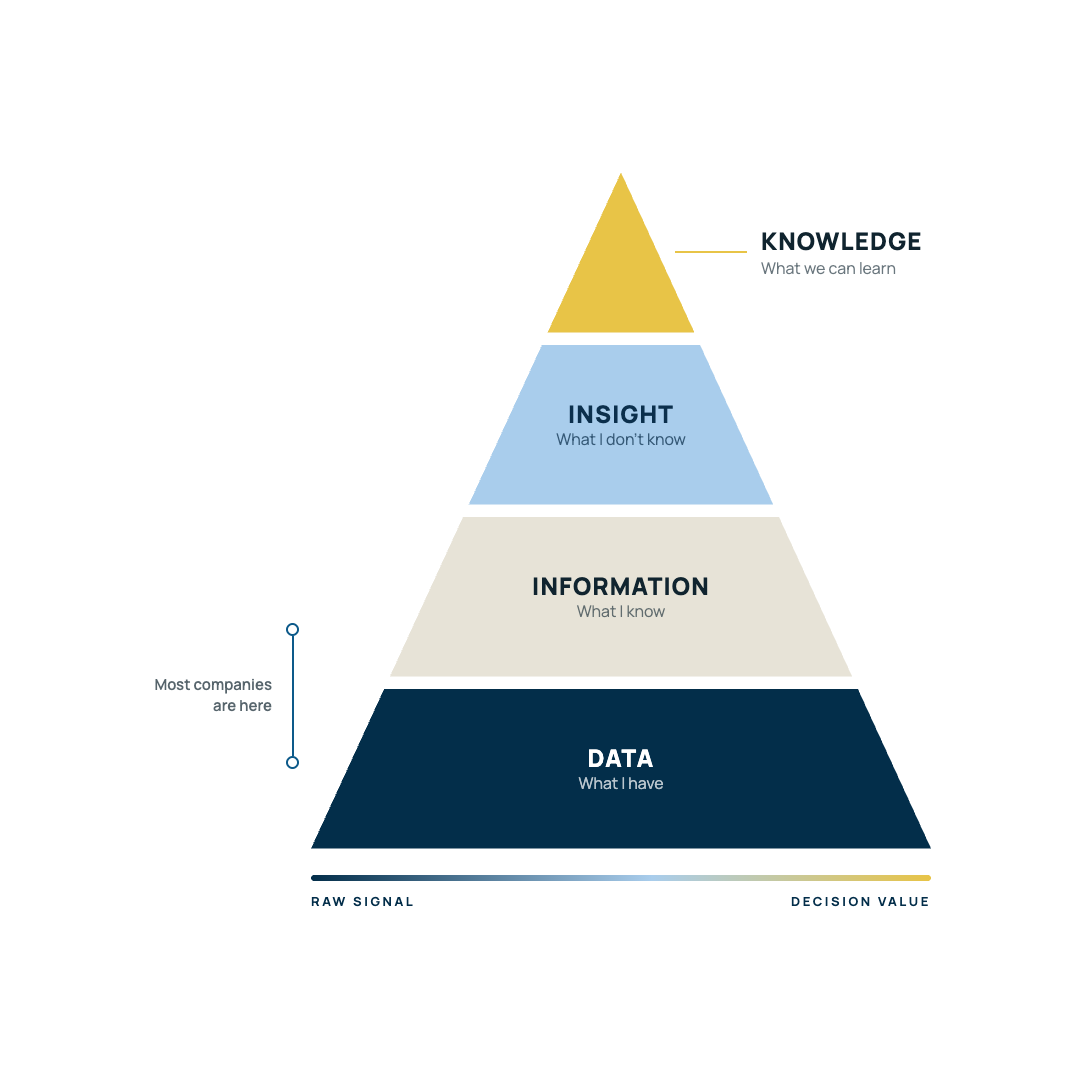
Our conceptual approach is always about finding the data that's actually useful and then structuring it in a way that leads to knowledge ... and action. It's the starting point that feeds all other strategic decisions for your organization.
"What are you trying to do with it?" is the guiding question that determines what's noise.
Most companies sit between Data and Information; the 844 Data Diagnostic is how you move higher - quickly.
What data do you have? Every field in your systems maps to exactly one of these eight domains; you may call them something else, but hundreds of engagements have proven these eight stand.
For each one, we inventory what exists, where it lives, and - critically - which system is the single source of truth.
Accounts, contacts, status, product usage, regions. Quickly answer "who's our customer and how do they use us?"
Opportunities, pipeline, forecast, and cross-sell / upsell ... this is a common area where far too much data is asked for.
This is separate from Sales due to its complexity and nuance that drives pricing strategy and margin analysis.
Orders, procurement, supplier data , etc. Often, a gap here vs. Quote flags a major data issue.
Billing, invoiced amounts, AR, and payment history shows buying patterns and churn risk.
Cases, tickets, support history, and SLAs; are there trends for preventable requests?
Campaigns, leads, engagement, and attribution ... the challenge here is often silos or lack of sales context.
Email, calls, messages, etc. are the "wild west" of unstructured data. Messy? Yes. But often a gold mine of tribal knowledge.
Having the data isn't the same as trusting it.
Every field gets scored across four dimensions with a field-level score (not an opinion) so "our data is bad" morphs into a defensible list of exactly what to fix first.
Does this field actually impact a specific business question?
Is it accurate, current, and trustworthy?
Does this data field help paint a clear picture?
Can it be used elsewhere (i.e. another team) without rework?

“I typically see about 50% of data passing the four Rs, but it's often much, much lower. For data that fails, small fixes to process or integration frequency are often enough ... or it's easy to eliminate them entirely because they were never useful to begin with.
This process doesn't take months; it's meant to go fast.”
This layer only applies once AI sits on top of the data and serves as the go/no-go gate before anything agentic touches a customer, a quote, or your ledger. Each P renders a Pass, At Risk, or Fail verdict.
Is there a specific, owned, baselined business decision the AI is actually supporting?
Is the data pipeline trustworthy enough to feed the model? (This gate inherits answers from the 4 Rs.)
Is there real ownership and accountability when the model gets it wrong, and training to ship a fix?
Are there success metrics in place and a way to measure improvement and adoption?
Your AI readiness must pass all four gates for an unqualified "Go" because a single weakness tanks your agent.
Once a domain is scored against the 4 Rs, it lands on exactly one of three verdicts ... ambiguity not included.
It works as-is, with a clear source of truth. Keep it, and put your attention elsewhere.
The data is real and usable, but it's in the wrong system, has the wrong owner, or has no agreed source of truth. Move it.
It's missing, or too untrustworthy to count on. Build it before anything gets layered on top.
An 844 Data Diagnostic is a low-risk starting point: it covers all eight domains, four Rs, and four Ps plus a 90-minute workshop with Andy Boettcher, architect of this methodology, so you have absolute clarity on what's working and what to do next.
It's a low-risk way to put us to the test; get started by reaching out.

Architecture. Before activation.