There are 46% more AI roles open than data infrastructure roles to support them. Here's what that mismatch costs.
Our 2026 talent-gap analysis maps business AI adoption against the AI workforce across US states and the 25 biggest metros.
Buying AI has never been easier: a few minutes, a credit card, and almost any business can be up and running. Making it deliver is the part that separates winners from the rest, and it takes a different kind of resource: an expert who can connect AI to a company's data and workflows.
At roughly $130,000 a year and concentrated in a handful of expensive cities, that talent is exactly what most businesses don't have on hand.
That is the real divide. Buying AI is easy, and getting easier; almost anyone can do it. Staffing AI with experts is the hard part, and not everyone can either afford to or find the talent locally. The driving question on who'll succeed may be as simple as "who has the people to help it pay off?"
We mapped exactly that across every US state and the 25 largest metros, and the answer splits the country in two: the places where companies can easily staff AI roles with local talent, and the places where they cannot.
We call this divide the talent gap; here is where it is, why it exists, and who it's about to catch out.
Hiring AI talent without fixing your data first is like hiring a race car driver and handing them a car with no engine.
-Andy Boettcher
AI adoption is no longer a Silicon Valley story. Around one in five US businesses now use it, and across the biggest metros, it's closer to one in four.
The tools are everywhere, cheap, and a sign-up away, but what's missing is making them work. When businesses told the Census what they actually changed to adopt AI, the most common answer was nothing at all: roughly two-thirds made no real changes. Of those that did, most simply asked existing staff to take it on. Only 1% hired anyone formally trained in AI, and about 4% hired consultants.
That is the first clue that many AI projects are destined to fail. It's the same pattern I've written about in why so many AI investments hire the wrong thing first. A technology this transformative is being adopted mostly by people doing it on the side of their existing jobs. Which raises the obvious question: why is nobody hiring the specialists?
Because the specialists are expensive and may be unaffordable for small-to mid-sized businesses.
Across the 10 AI-compatible job titles we analyzed (refer to our FAQ section to see the full list), the median worker earns about $130,000 a year - each role's median weighted by how many people do it. That is roughly 2.6 times that of the typical American worker, and a good deal more once you add benefits and overhead. For a company with thousands of staff, that is a rounding error.
For a four-person marketing shop in Phoenix that is curious about AI, it may be more than the founder pays themselves.
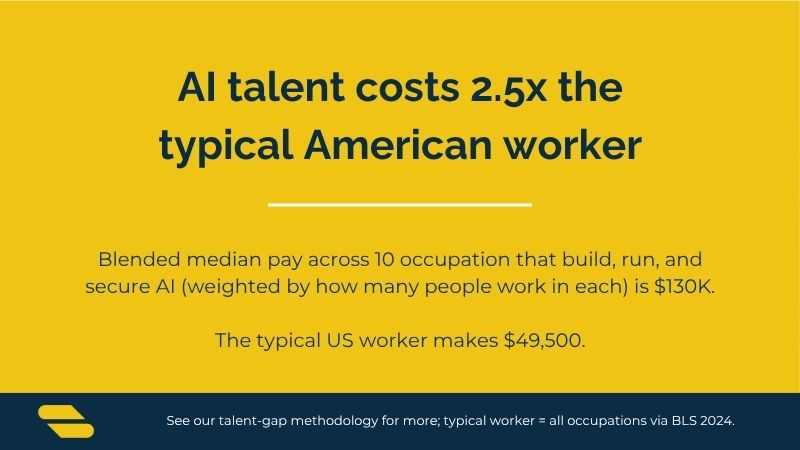
In the markets where the talent clusters, the price climbs higher still: a blended median of about $159,900 in California and $159,200 in Washington State, rising to $178,400 in San Francisco and $166,900 in Seattle at the metro level.
And in the places where specialists are scarcest, where Mississippi pays the least at about $92,600, the problem may not be the price but rather the lack of local talent - a small business chasing AI across much of the country faces both at once: scarcity and a salary premium.
Related: discover our data-first approach that doesn't cost three FTEs
So it's no mystery who's pulling ahead. AI use climbs steadily with company size, from around one in six of the smallest firms to nearly one in three of the largest.
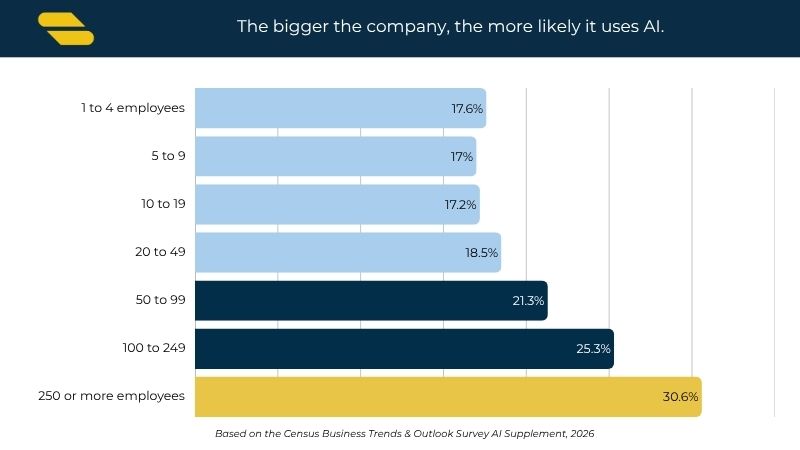
The logic is brutally simple. A big company can hire someone with deep data and AI expertise, run a pilot that flops, and try again next quarter.
That Phoenix marketing shop gets one shot, cannot justify a six-figure hire against a maybe, and so trains someone up or waits. The result is a widening divide that has little to do with ambition and everything to do with who can absorb the cost.
AI adoption also varies by industry, since a software firm and a construction firm face different needs and different barriers to entry.
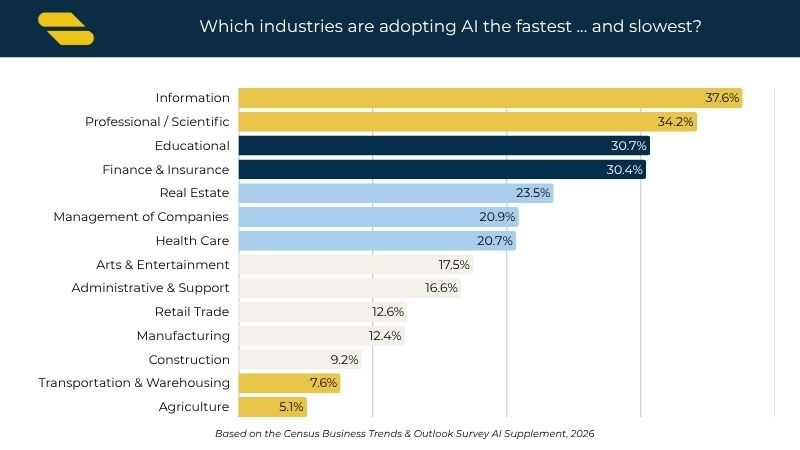
Knowledge-heavy industries, from tech and professional services to finance and education, already employ the analysts and engineers who make AI land, and they have raced ahead.
The physical and service trades (construction, hospitality, agriculture) have the furthest to go and the least support getting there.
If you would guess that the places adopting AI fastest are the ones with the most AI talent, the data says otherwise.
The widest talent gaps are in the Sun Belt. Phoenix tops the list: a third of its businesses report using AI, well above the national average, despite having fewer data scientists per capita than most metros. San Antonio, San Diego and Miami follow the same pattern, reaching fast and staffing thin. Among states, Arizona, Colorado, and Nevada lead the same way.
At the opposite end of the spectrum, San Francisco has the deepest bench of data scientists of any major metro, with nearly 4 per 1,000 jobs. New York, Boston and Seattle are not far behind. These are the places best equipped to turn AI ambition into working systems, and their businesses are adopting at a perfectly healthy clip, just not faster than their talent can handle.
The specialists who could rescue a stalled project in Phoenix are sitting, fully employed and well paid, two time zones away.
And the gap is set to widen. The places where businesses say they will adopt AI over the next six months, well ahead of where they are today, are mostly the same places already short on talent: Miami, Houston and Denver among the metros, South Dakota and South Carolina among the states.
The pressure is building exactly where the capacity to handle it is weakest.
Related: data architecture consulting that fixes the underlying problems
If you ask, talent's rarely their answer:
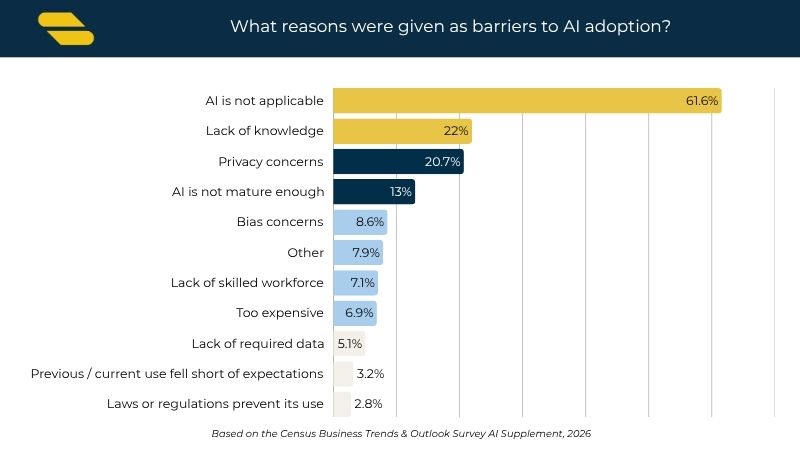
Ask those not planning to use AI why, and top answers revolve around perceived relevancy, understanding, and/or privacy. The shortage of skilled people is named by only about one in fourteen.
The talent gap is a structural fact read straight off the wages and supply, more than a problem businesses consciously feel ... which means these businesses notice the symptom (such as a project that stalls or never starts) long before they diagnose a root cause.
The distance between buying AI and making it work is where the money is won or lost. The research is blunt: the vast majority of corporate AI pilots deliver little to no measurable impact on the bottom line, and the reason is rarely the technology itself. Rather, it's the foundation underneath, the data, the workflows, and the people who can wire them together.
And this is not only a small-business problem. The four-person shop in Phoenix may be priced out of a data scientist entirely, but a mid-market or enterprise company in the same market hits a different version of the same wall - it cannot hire fast enough to address a national shortage, pays a premium when it does, and a single specialist parachuted into a messy data estate ≠ a working AI capability.
This is why so many well-funded pilots still stall: the talent gap is only half the story, and the underlying data foundation is the other half. AI bolted onto chaos just produces chaos faster.
So the talent gap is a build-or-buy question in disguise, and the honest answer is usually neither. Not everyone can afford to hire a data scientist, but they can afford to work with one.
For the organizations that can invest, the winning move is not to outspend in a local hiring war. It is to fix the data foundation first, then partner on the capabilities that make AI actually run, rather than assembling an entire team from scratch in a market where talent barely exists.
In the AI era, the winners will not be the businesses that spent the most, or even the ones that hired the most. They will be the ones who built the foundation first and brought in the people who had done it before.
Related: AI enablement consulting built to close this exact gap
There is no single 'AI engineer' or 'machine learning engineer' occupation in the federal job classification, so we built our measure from the 10 occupations most aligned to working successfully with AI, as published by the Bureau of Labor Statistics: Data Scientists, Computer & Information Research Scientists, Operations Research Analysts, Database Architects (where most data engineers are classified), Database Administrators, Computer Systems Analysts (which captures many enterprise architects), Information Security Analysts, Computer Network Architects, Computer Programmers, and Computer & Information Systems Managers - roughly 2.1 million people who build, deploy, secure and manage AI systems.
We deliberately excluded three large occupations that would have measured the size of the tech sector rather than AI capability: Software Developers (1.65 million, overwhelmingly non-AI), Management Analysts (where in-house transformation roles sit, but dominated by general consultants) and Chief Executives (where a Chief Innovation Officer would be coded, alongside every other CEO).
We tested the rankings against narrower and broader definitions, and the metro ordering holds.
The Census publishes a margin of error for every figure, and we carry it through. At the state level, those margins are wide enough, around five points, that we caution against reading too much into small differences between similar states.
The metro-level results and the broad Sun Belt-versus-coast pattern are far more robust, and that is where we put the weight.
No. It means adoption is currently outrunning local specialist supply, which can be a sign of healthy ambition. The point is that ambition alone does not implement AI, and these are the markets where the question of implementation is most pressing.
US Census Bureau, Business Trends and Outlook Survey (BTOS), AI supplement: the share of businesses using AI in any business function, plus six-month intent, firm size, and sector, by state and the 25 most populous metros.
Source: https://www.census.gov/hfp/btos/data
US Bureau of Labor Statistics, Occupational Employment and Wage Statistics (OEWS), May 2024: data scientists (SOC 15-2051) per 1,000 jobs and median annual wages, by national, state, and metro.
Source: https://www.bls.gov/oes/
Each measure is standardized (z-score) across the geographies in scope, and the gap is the standardized adoption minus the standardized talent. Wyoming is excluded as the BLS does not publish a data scientist estimate for the state. All figures are reproducible from the two public sources above.

Architecture. Before activation.