Many revenue leaders are investing in AI right now, from AI-driven forecasting to agentic quoting, intelligent approvals, and more dynamic pipeline scoring. I and our teams are working on some of this today for our clients!
And all of these promise better insights and faster execution. The investment is real: according to Gong's 2026 State of Revenue AI report, AI adoption among sales teams has accelerated significantly.
And yet.
That same report showed quota attainment has continued to fall for many organizations using it. And Clari Labs discovered nearly half of those surveyed said their revenue data simply wasn't ready for AI - almost half didn't even have formal governance frameworks in place!
This isn't about tools - sorry, but I've seen a lot of sales leaders buy a tool to fix a problem and that never works out. The question you need to ask is: can you clearly tell the story of a customer from first touch to renewal?
If you can't, your revenue engine isn't ready for AI and you're likely to become the wrong half of the next Clari report. My colleague Andy Boettcher highlighted some reasons why in his article of why AI pilots aren't going live, but I'd like to dig deeper into why sales teams really aren't ready for AI.
The Customer Story Test For Sales AI Readiness
When AI's brought up - and it almost always is these days - I default to this test as a way to show potential gaps that'll become worse with AI.
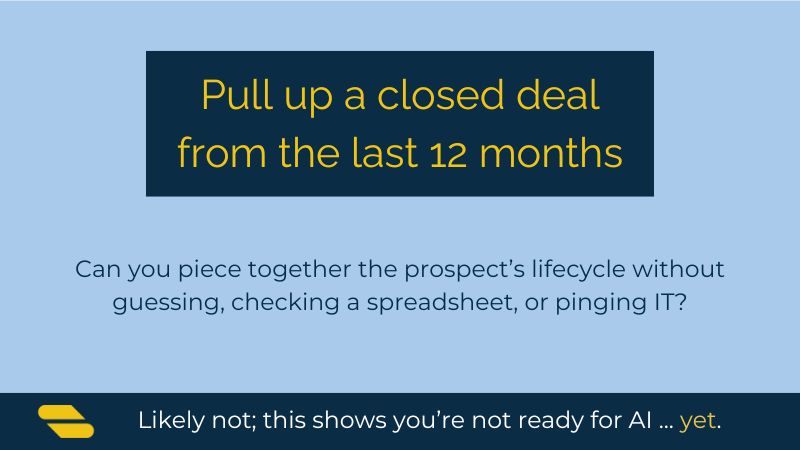
Take a customer that closed in the last 12 months and walk through their lifecycle. Can you tell me (without needing to reference a call log or spreadsheet, but using what's on the screen) the following?
- When did they first visit your website?
- What campaign did they engage with?
- When did Sales first contact them?
- How did the opportunity progress?
- How many quotes were generated?
- Which quote was accepted?
- What invoice was issued?
- What products were provisioned?
- When did they renew?
- What was the margin on the deal?
Now ask yourself: Can we connect all of that across systems without guessing?
Without a spreadsheet merge. Without a conversation with IT. Without an honest "I'm not sure."
Anything but a firm, confident “yes” means you're not ready.
But the good news is there's clear place to start, and our data-first approach paves the way by focusing on the underlying architecture that drives what data's actually useful vs. what's empty noise slowing you down.
Related: read about the four Ps of AI readiness
Why Lifecycle Continuity Matters
AI systems depend on structured, connected data.
If "Joe Smith" appears in one system as a marketing lead, in another as an opportunity contact, and in a third under a slightly different account name tied to an invoice, AI won't automatically fix those inconsistencies.
It draws conclusions based on the inputs it receives. So if those inputs are fragmented or inconsistent, insights will be, too - or worse, they'll look confident when they're 100% wrong.
Wrong answers? That'll happen. The real problem is when wrong answers are given with confidence that causes you to act instead of questioning the outcome. Bad decisions compound and lead to misses.
Forrester's Sales and Marketing Alignment Survey found that 65% of sales and marketing professionals report a lack of alignment between their organization's leaders, even as 82% of C-suite executives believe their teams are already in sync. That perception gap is exactly where AI fails: leadership believes the data is connected because the systems exist.
And our research into the cost of bad data shows the cost: over $600B annually for US business. The systems exist, but the data flowing between them isn't.

The Hallmarks of AI-Ready Revenue Architecture
IDC research agrees, saying "organizations with the most advanced AI infrastructure and data governance achieved 24.1% revenue improvement and 25.4% improvement in cost savings, significantly outperforming less mature peers."
I find three things must be true before declaring “yeah, you're ready for AI now.”
First, there is consistent account identity across systems. CRM, ERP, billing, and marketing platforms share unique identifiers. "Acme Inc." is the same entity everywhere … it's not "Acme," "Acme Inc.," and "Acme Incorporated" living in three different places.
Second, data flows automatically at handoffs. Leads convert without re-entry. Quotes generate from opportunities. Invoices reference accepted quotes. Renewals reference original contracts.
If any of those handoffs require a human to copy and paste, you have a lifecycle gap. This is a common pitfall for the marketing-to-revenue process.
Third, there is no hidden human intervention correcting outputs before they reach reporting. If someone in accounting is manually adjusting invoice values before final posting, your system isn't creating trustworthy data ... which means AI isn't surfacing trustworthy insights.
The Misconception About AI in Revenue
One of the most common things I hear is that AI will "clean up" revenue complexity. I kid you not, I've heard this from CEOs to VPs of Sales in different industries and ARR ranges.
Every time I have to be blunt: no, it will not!
McKinsey's research on sales and marketing alignment found that companies with strong alignment achieve 19% faster revenue growth and 15% higher profitability. That isn't from better tools, it's from connected data and shared definitions that make those tools work.
AI doesn't replace discipline - it builds on top of it and rewards you if it's a strong foundation. But the reverse is true, that it'll amplify any crack in your revenue architecture.
I don't care how sophisticated your model is or how expensive … your AI will not compensate for the quality of the inputs if these are poor.
Practical Steps to Evaluate Readiness
Before declaring your AI readiness doesn't need work, answer these four questions honestly:
Identity Continuity Can you track a single customer across marketing, CRM, quoting, billing, and renewal without confusion or needing to fix a slight error?
If the same account appears under different names or identifiers across systems, your AI will treat them as different.
Handoff Automation Are there any points where data is manually re-entered between systems?
Every manual re-entry is a point where data degrades. Salesforce's own research on attribution modeling found that 41% of marketing organizations are using attribution modeling to measure ROI, but most do not set it up until month six or later, precisely because the underlying data infrastructure was not ready at launch.
Reporting Reconciliation Do your revenue reports require spreadsheet adjustments to align Sales and Finance numbers?
If the answer is yes, you have two versions of the truth. AI trained on either version will reflect that split, but training it on both requires extra time and maintenance (and this doesn't scale well).
Historical Consistency Is your legacy data structured consistently enough to support multi-year analysis?
AI-driven forecasting and pipeline scoring depend on pattern recognition over time. If your historical data uses inconsistent definitions, field naming, or account structures, the patterns AI finds will be artifacts of the data problems and not signals of actual business behavior.
You likely need to fix the underlying data architecture first. Most do - and that's okay! Starting at the right spot in your journey to better-use AI in your sales and revenue motions is critical to getting fast return on your investment.
Racing ahead with “just using” AI doesn't.
What Does Not Change
Technology will continue to evolve: Quoting will become more conversational, forecasting models more sophisticated, and AI agents will handle more of the routine work inside revenue operations.
What does not change is the need for clean, connected data with governance and solid infrastructure supporting it.
Even as AI becomes more capable, revenue systems will still require disciplined architecture and consistent identity management across every handoff from marketing to sales to billing to renewal.
If you can't confidently answer basic lifecycle questions today, focus there first. Once you can clearly tell the story of your customer from first touch to renewal, AI becomes an accelerator.
Without that clarity, it becomes noise … expensive, confident-sounding noise that hurts your entire quote-to-cash system.