
Salesforce CPQ-to-RCA transition is not a lift-and-shift project

Updated: Feb 11
Having been apart of multiple engagements and scoping calls, I say this with confidence: most companies approaching Revenue Cloud Advanced (RCA) today have the wrong approach.
Since RCA's arrival in the Salesforce ecosystem, discussion for end-users largely revolves around replacing CPQ with the new tool. However, this is not only an opportunity to upgrade your technology - but also improve your business processes.
Put another way, moving to RCA is not just a matter of swapping out and old technology, plugging in the new one, and carrying on with business as usual.
That mindset guarantees disappointment, because RCA is not a straightforward replacement for Salesforce CPQ. It’s not CPQ with a fresh coat of paint!
It is an entirely different architecture built to support how modern companies sell across multiple channels, markets, and products.

Treating it like a lift-and-shift project means you will recreate the same inefficiencies, technical debt, and limitations you already have, only now inside a more powerful system you are not taking advantage of.
Revenue Cloud Advanced presents an opportunity for a business upgrade as opposed to being an IT project - for those whom it’s a fit.
Related: Revenue Cloud is one platform we work with in our lead-to-cash consulting services
The wrong starting point: “We just need to replace CPQ”
If your first instinct is to replace CPQ because Salesforce stopped selling new CPQ licenses, you’re already on the wrong path. This is not a good enough reason!
First, CPQ is not disappearing - it is not nearing end-of-life status. There are billions of dollars of revenue flowing through it every year, and Salesforce is not going to pull the plug on customers who rely on it without some sort of major advance notice - one I don’t think is going to happen for a few years at least.
Second, don’t fall into the trap of approaching this from a tech-first lens. You need a business-first and data-first mindset that aligns what you’re trying to accomplish with what your business truly needs - that includes everything flowing into and around your CPQ instance.
Third, re-platforming to replicate your past is asking for a negative ROI. How you use CPQ today doesn’t mean it’s optimal for how your business should function, nor does it guarantee success five years from now.
Companies will waste hundreds of thousands of dollars implementing Revenue Cloud Advanced by putting CPQ on one monitor, RCA on the other, and manually rebuilding your existing configuration.
Why would you guarantee the same pain points you already live with? Instead, ask yourself:
What problems do you want to eliminate?
What revenue opportunities do you want to enable?
What data do you need to support these - and what is just noise?
Why CPQ logic does not belong in Revenue Cloud Advanced
Most CPQ orgs look the way they do because they’ve survived ten years of patches, exceptions, and tactical fixes piled on top of each other.
Every new product launch, discount model, SKU variant, edge case, and sales exception added another layer of complexity. Over time, those layers turn into technical debt that nobody wants to unwind.
Trying to recreate that exact logic inside Revenue Cloud Advanced is a mistake because CPQ and RCA are not the same type of system.
CPQ is a rules-based, template-driven engine.
It was designed to evaluate sets of rules in sequence and determine valid configurations based on those rules. That approach worked well for traditional inside sales motions, but it made complexity very expensive. Any time pricing logic spanned multiple rules, rule sets, price rules, price conditions, lookup tables, and custom code, the engine became harder to maintain.
And for many customers, that is exactly what happened - I can’t tell you how many times I’ve unwound this!
Revenue Cloud Advanced is built on a fundamentally different architecture.
RCA uses a data-model-driven pricing framework. Instead of stitching together rules to emulate pricing behavior, RCA gives you a unified pricing brain with native capabilities for dynamic pricing, advanced discounting, attribute-based configuration, and cross-channel consistency.
The engine is designed to react to data, not wait for sequential rule evaluations. It is inherently more flexible, more transparent, and more scalable.
That difference is why “lift and shift” does not work.
If your plan is to open CPQ in one browser tab, open Revenue Cloud Advanced in another, and rebuild every rule, price action, constraint, and custom lookup table line by line, you will not get the system you paid for. You will simply re-platform your technical debt and with a higher price tag.
Here’s a real-world example:
Many CPQ orgs have enormous pricing lookup tables with tens of thousands of permutations. Those tables became the workaround for a pricing strategy that evolved faster than the system could keep up.
There is also the channel problem. CPQ could never expose its pricing logic to e-commerce or self-service experiences without duplicating the configuration engine in another system. That meant companies ended up maintaining the same logic twice, and every update created double the work.
RCA eliminates that, but only if the pricing model is rebuilt intentionally. If you drag CPQ’s brittle rule stacks and SKU-by-SKU edge cases into RCA, you lose the benefit of having one pricing brain for every channel.
And that same model around pricing tables is a signal that something upstream needs to change. Pricing complexity should be simplified, not transferred. A million price permutations should become a clean, data-driven pricing model that is easier for sales, partners, and end customers to navigate.
Simplify Selling
This is why the transition to Revenue Cloud Advanced is a transformative exercise, not a technology migration. RCA works best when companies treat it as an opportunity to flatten their catalog, remove unnecessary attributes, rethink bundling, and design a pricing model aligned with how people actually buy.
Customers want the Amazon experience. They want to see a product, choose a meaningful set of options, understand the price, and check out. They are not going to complete a quote that requires seventy-five fields of configuration logic and a maze of rule-driven pricing actions.
The complexity that sales reps were willing to tolerate in CPQ will kill conversion in an e-commerce or partner self-service environment.
RCA can handle sophisticated pricing … because it was built for it! But that sophistication should come from intentional pricing strategy, not inherited complexity.
When to consider Revenue Cloud Advanced
Revenue Cloud Advanced is worth the investment if you have significantly-diverse channel sales experiences or want to expand how you sell.
If you are planning for:
e-commerce
partner channels
self-service buying
guided product discovery on your website
abandoned-cart handoff between digital and sales
consistent pricing across every sales motion
…then Revenue Cloud Advanced belongs on your roadmap.
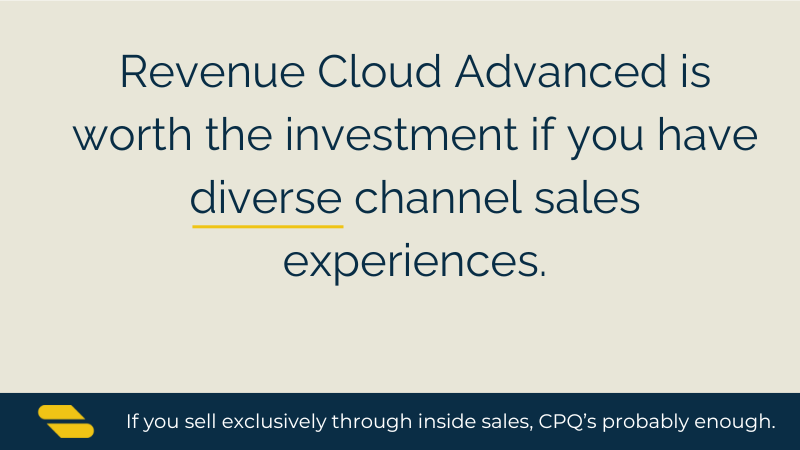
CPQ was never designed for omni-channel selling; it was built for inside sales teams. As soon as you add a second sales motion like e-commerce or a partner marketplace, CPQ forces you into maintaining duplicate logic across multiple systems. That leads to inconsistent pricing, longer maintenance cycles, and unnecessary friction when anything changes.
Revenue Cloud Advanced changes this entirely, giving you a unified pricing and configuration engine that runs across every channel. One hub, using one data model, with one set of pricing rules powering sales, partners, e-commerce, and renewals.
That is the real transformation potential: RCA lets you pull all your channels into a single quoting and pricing experience instead of stitching them together.
If you only sell through inside sales, you may not need RCA
Here is the part most partners will not say, but just like any technology, there are use cases where you’ll gain excellent value - and cases where the ROI isn’t there.
If you sell exclusively through an internal sales team with no plans to add e-commerce or partner channels, CPQ may be enough for you. I’d recommend exploring ways to get more out of the platform (a few ideas are right here).
In all honesty, there are plenty of solid CPQ implementations out there that can run efficiently for years with the right clean-up and governance. And again, I am many others in the field do not anticipate Salesforce rushing to get rid of CPQ - not with how much is at stake.
Revenue Cloud Advanced makes the most sense when your future includes additional channels, more self-service, or a new digital buying experience.
If that is not on your roadmap, you should not feel pressure to move.
Treat Revenue Cloud Advanced as a business transformation, not a technology project
You cannot maximize Revenue Cloud Advanced without rethinking more than your tools. Taking a data-first mindset is vital, such as revisiting:
Product bundle design
Pricing logic - what’s necessary? How much is legacy?
Discounting
Buyer purchase experiences
How sales, partners, self-service, and billing interact
How FP&A consumes pricing data for modeling and forecasting
This is why we do not walk into an RCA project with pre-written assumptions; outcome-first design workshops are critical.
In these workshops, we examine pain points across your revenue lifecycle, align on the experience you want your customers and sellers to have, and only then do we begin to design the pricing and product architecture that gets you there.
Yes, this takes more time - but it also means you'll get this right the first time and aligned to your business outcomes that matter most ... instead of having to fix and duct tape things together for 2-3 years.
Don’t guarantee yourself disappointment
If you approach Revenue Cloud Advanced as a CPQ replacement, you will get CPQ results. If you approach it as a business model upgrade, you can build a cleaner, faster, more scalable revenue architecture that supports every channel you care about today and every channel you want to add tomorrow.
Revenue Cloud Advanced is powerful, but only when you treat it like the strategic investment it is and with the right use cases + data foundations to support it
The organizations that get the most value out of RCA are the ones willing to rethink how they go to market. The ones who use this moment not to repeat the past, but to improve it.
If you are evaluating Revenue Cloud Advanced and want to understand what it means for your channels, your pricing model, and your long-term revenue strategy, reach out. These decisions shape more than the next year of your tech stack. They shape the next decade of your business.


