
The Four Ps of AI Readiness: Why Good Data Still Isn't Enough

If you've read anything else we've published on our data-first methodology, you already know the four Rs test; we map an organization's data into eight domains and score each against the Four Rs: relevant, reliable, revealing, reusable.
That work tells you what data you have and whether it's any good, but it doesn’t by itself let you activate on it - such as AI deployments.
I look at our full methodology as ready, set, go:
The eight domains are the “ready.”
Four Rs are the “set.”
And your four Ps are the go … the part that turns good data into an actual, working, trustworthy AI deployment.
Here's what they are, why each one exists, and which one will most likely be the reason your next AI project stalls.
Jump to a section: Purpose | Plumbing | People | Performance | Which is hardest? | Knowing you're ready | Why trust the Four Ps? | FAQs
The Four Ps of AI Readiness: A Quick Reference
DoubleTrack's Four Ps framework determines whether an organization is ready to deploy AI on top of data that has already passed the Eight Domains and Four Rs stages of the 844 Methodology:
Purpose. Is there a clear, business-anchored reason for this AI investment, with a named outcome and owner?
Plumbing. Is the data infrastructure, integration platforms, pipelines, publish/consume flows, actually built to move data to where the AI needs it?
People. Do the humans around the AI understand it, own it, govern it, and trust it enough to actually use it?
Performance. Is there a defined success baseline and ongoing monitoring to know whether the AI is actually working?
Purpose
Is there a clear, business-anchored reason for this AI investment? What outcome is it supposed to drive? Who owns it?
I ask those three questions in almost every engagement, and I ask them early, because they kill a very specific and very common failure mode: the board told me to do AI, so I'm doing AI.
That's not purpose! I’d argue it’s a mandate with no destination, and a project with no destination quietly drifts until someone asks what it actually accomplished while nobody has a good answer.
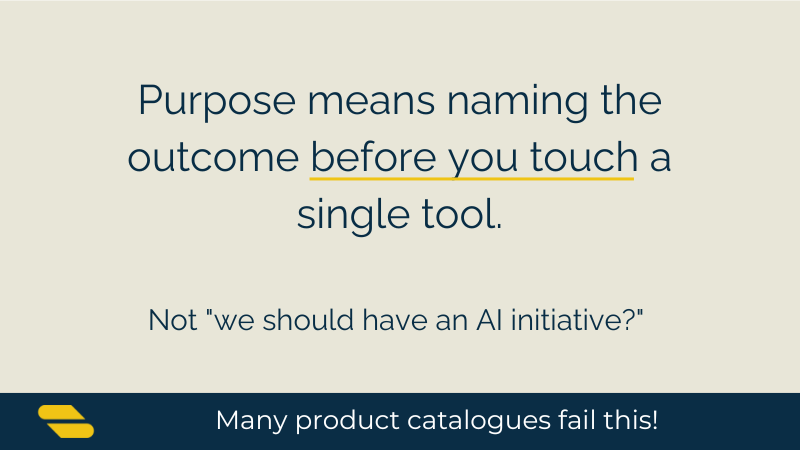
Purpose means naming the outcome before you touch a single tool.
Not "we should have an AI initiative." Sorry, seen that play out, it wastes budget immediately; your purpose has to be specific enough that you'd immediately know if it works.
Plumbing
Is the data infrastructure actually ready to support this?
Do you have the integration platforms you need? Are your publish and consume flows, your pipelines, your external access all built to actually move data from where it lives to where the AI needs it?
This is where the Eight Domains and Four Rs work stops being theoretical and starts becoming operational. You can have beautifully scored, relevant, reliable data sitting in a system and still have no way to actually leverage it.
Your plumbing must be delivered to your AI, in the specific format it needs, and with regular updates shipped. And you have to be able to audit this to track when (not “if”) something goes awry.
I'll say this plainly, because I want it to land: this is where most of these projects fail.
Your data architecture - the plumbing - is everything.
People
I've written before about treating AI like an employee, not a piece of software; now it’s time to apply that idea.
You wouldn't hire someone without qualifying them, right? No right-minded leader would take a new hire and throw them into a role without training them … and you definitely wouldn’t let them run unsupervised without some form of ongoing feedback!
AI demands the same discipline, but the People P isn't really about the AI.

It’s about the humans around that AI interacting and supposedly owning its accountability.
If AI is something that got magically dropped on your people’s desk, they don’t own it and you’re far more likely to fail. And do they understand why they need to govern it and maintain it, much less what good observability looks like? None of this is the click of a button.
But the most important question is also the simplest: will they actually trust and use the thing?
If the answer is no, everything upstream (the domains, the Rs, the purpose, the plumbing) doesn't matter because an AI tool nobody trusts is an AI tool nobody uses.
Performance
None of this matters unless you can measure success, right?
Performance means having a baseline before you launch; this includes success metrics defined in advance and then ongoing monitoring / governance once the thing is actually live to continuously improve towards that goal.
For instance, we launched an agent for a specific internal team to use in their product quoting for customers. The goal was to have 90% answer accuracy, which was helped by asking users for immediate thumbs up/down feedback on how the chat went.
Initially, the launch was closer to 80%, but after seeing the trends in initial thumbs-down conversations we quickly updated the plumbing and helped people (such as noting what support documents used by the AI had outdated information).
Within a month, we’d hit 90% and adoption spiked as the agent tripled in usage!
This is the P that turns "we launched something" into "we know whether it's working" and it's the one that gets skipped most often, because by the time an organization reaches deployment, everyone's exhausted and ready to call it done.
Performance is where you find out whether it’s actually done.
Which one of the Four Ps is the hardest? It’s People, hands down.
I don't hedge on this one: people are chaotic beings. (I'm just as guilty.)
Every one of the Four Ps requires real discipline, but People is the one that carries change management with it, long the single biggest killer of technology projects before AI showed up. Traditional IT rollouts, CRM implementations, ERP migrations … you name it, change management was always the part that quietly took them down.
AI doesn't get a pass on that just because the technology is new and impressive.
Which one matters most? All of them.
People ask me this expecting me to pick a favorite. I can't, because that's not how the Four Ps work.
Each one exists for a specific reason, and skipping any single one raises your risk of ending up with another failed AI project. They're not four scores you average together., but act as four different gates you have to clear.
How do you actually know if you're ready for AI?
Run the 844 methodology … not gut instinct or feeling.
An evidence-based plan is the whole point of the 844 approach because it gives you factual, testable proof of where you stand. That's the difference between an organization that knows it's ready and one that's hoping it is; good news, you can start testing it yourself with our 844 Snapshot.
One client example I can point to involved zero technology in the early going … no tools, platforms, integrations, AI vendor demos, etc. It was just people, in a room, working through the Eight Domains and Four Rs together and learning “this is what data you have, this is why it exists, this is why it matters, this is how to think about it.”
There wasn't an AI project on the table yet at that point.

But the groundwork from that work became the standing framework for every decision that followed and became the default reference point any time a question came up.
I know, it’s not a flashy story that grabs headlines. Sorry to my marketing team on that one, but the truth is good looks boring. It’s not about some magical breakthrough moment that sounds great on a conference stage.
It's about an established, measured, repeatable process that holds up under real scrutiny. Evidence over opinion, every time.
Why the Four Ps?
There's a narrative running through a lot of AI content right now … some of it from the platforms themselves, some of it from what I'd call the AI-sycophant content flooding LinkedIn … that says this is all easy now.
“Anyone can do it. You don't need anyone's help.”
It's not true, and I'd push back on anyone who tells you otherwise.
Yes, we can do more today, faster and deeper, than we've ever been able to do as technologists. That part's real, but cybersecurity is still a thing. So’s product management, much less change management.
None of those disciplines went away because the tools got more capable. I’d argue they’re more important than ever considering the stakes involved.
And that’s what the Four Ps are for: to make sure that when you do move, you're moving on solid ground.
Frequently Asked Questions (FAQ)
What are the Four Ps of AI readiness?
The Four Ps of AI readiness are Purpose, Plumbing, People, and Performance and represent DoubleTrack's framework for determining whether an organization is ready to deploy AI successfully.
Purpose asks whether there's a clear, business-anchored reason for the investment.
Plumbing asks whether the data infrastructure can actually deliver data to the AI in the format and cadence it needs.
People asks whether the humans around the AI understand, govern, and trust it enough to use it.
Performance asks whether success is defined and measured before and after launch.
The Four Ps represent the final stage of DoubleTrack's 844 Methodology, following the Eight Domains of data and the Four Rs data quality assessment.
What is the difference between AI readiness and being AI-ready?
Good data and AI readiness are related, but not the same; data can score well on DoubleTrack's Four Rs test (what’s relevant, reliable, revealing, reusable) and an organization can still fail at AI if the surrounding infrastructure, people, and measurement systems aren't in place.
AI readiness requires the data to actually reach the AI system in a usable form (Plumbing), the people around it to trust and govern it (People), and a defined way to measure whether it's working (Performance) while staying anchored to a clear business purpose.
Good data is a precondition for AI readiness, but it’s not a substitute for it.
Which of the Four Ps is hardest to get right?
According to Andy Boettcher, DoubleTrack's Chief Innovation Officer, People is the hardest of the Four Ps. Every AI deployment carries change management risk, which is the same discipline that has determined the success or failure of CRM implementations, ERP migrations, and other major technology rollouts for decades.
AI doesn't get a pass on that risk simply because the technology is newer and more capable; if the people around an AI system don't trust or use it, none of the other three Ps (Purpose, Plumbing, or Performance) matter.
How is AI readiness different from having good data?
DoubleTrack recommends an evidence-based assessment rather than relying on instinct. Its 844 Methodology walks organizations through three sequential stages: the Eight Domains of data (what data exists), the Four Rs (whether that data is relevant, reliable, revealing, and reusable), and the Four Ps (whether the organization can act on it: Purpose, Plumbing, People, and Performance).
Rather than scoring these as four numbers to average, DoubleTrack treats each of the four Ps of AI readiness as a distinct gate that must be cleared, since a failure in any one puts an AI deployment at risk.


