Let me be upfront: if you’re looking around because you think Salesforce is getting rid of CPQ, you’re a bit early! Salesforce is not taking down CPQ … yet. It’s end of sale, but not end of life; those who have it today can keep using it.
But just because it’s not “dead” doesn’t mean it’s a platform you should keep investing in long-term. So, if you’re considering a CPQ migration, it’s worth getting an accurate picture.
What's Actually Happening to Salesforce CPQ
Salesforce stopped selling new CPQ licenses as of March 2025. Unfortunately, you get people in places like LinkedIn, Reddit, and others claiming otherwise (“you need to migrate now!”) when they’re simply wrong as of this writing.
- It's not end-of-life. Existing CPQ customers keep their licenses, can add users, and continue to renew. Salesforce hasn't announced a shutdown date, and based on how much revenue still runs through CPQ today with 70,000+ customers, I don’t think that’s happening until they feel very confident in their Agentforce Revenue Management (prev. Revenue Cloud Advanced) offering.
- Minimal updates and fixes. CPQ will keep receiving security updates and critical fixes, but that’s about it from Salesforce’s side. Understandably, they’re focusing all development (two+ years to date) on their newest, in-house offering.
- New customers don't have the option. If you're evaluating a quote-to-cash platform today and don't already have CPQ, you're choosing between RCA and other market alternatives like DealHub, Conga, Nue, or others.
From Salesforce’s vantage point, CPQ has moved into a maintenance phase.
If You Already Have Salesforce CPQ: Should You Migrate?
As much as I’d love to tell you “yes, and we help with that” that’d go against everything we stand for; the right answer is that it depends on how you sell today, even if there are excellent CPQ alternatives (including Dealhub, Conga, Nue, and more).
Stay on Salesforce CPQ if you have:
- A relatively simple, single-channel (inside sales) sales process
- Simple renewals, or few of them
- A small team managing the instance
- No near-term plans for e-commerce or partner/self-service selling
If quote times are fast and accurate and your quote-to-cash process isn’t a barrier, why fix something that isn’t broken? Especially if you also layered in Salesforce Billing for invoicing built off of standard sales objects.
Start seriously evaluating a move if you:
- Sell across multiple channels (inside sales plus any combination of e-commerce, self-service, or partner portals)
- Are actively planning to add a digital or partner channel in the next year or two (the architecture decision needs to happen before that investment, not after)
- Struggle with mid-term add-ons or customer upgrades
- Have a new pricing model that will demand an overhaul of your pricing catalog anyway
- Are already fighting CPQ's custom-object complexity on a regular basis
If your answer is closer to the first list, don't let "Salesforce stopped selling it" alone push you into a migration project with no clear business case. I’m hearing stories of Salesforce sales reps trying to push people into their latest platform, but it’s not a simple lift-and-shift maneuver and we have found ourselves recommending other platforms more often.
Is a Salesforce CPQ Migration Worth It?
Before committing budget to either a broader CPQ clean-up or a full migration, it's worth running the numbers rather than assuming the case is obvious. Look at metrics across your business impacted:
- Revenue Operations: how much time is being spent maintaining a system that’ll eventually go away? Is more time spent chasing / fixing sales quoting problems?
- Accounting: time-to-invoice, time until payment is actually received, manual fixes based on invoicing / billing
- IT: volume of Salesforce-related support requests, time spent on ongoing platform development (including break/fix items)
- C-Suite: how quickly leadership can get accurate, trustworthy top-level reporting when they ask for it?
Your answer might absolutely be “this is fine for now,” and if so … that’s okay! Keep a migration on the horizon since it’s unknown when Salesforce will announce the platform’s end, but for now you can keep on.
But if you’re investing a lot of time and resources to make a 10+ year old system work, it might be time to look at moving on. We’d recommend starting at the data layer and getting your foundations right; no other CPQ platform can fix a convoluted pricing catalog with broken logic.
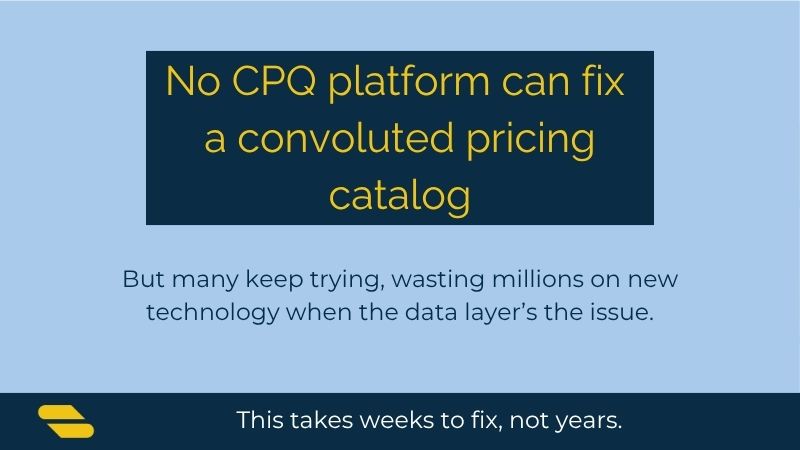
Because data is platform-agnostic - data-layer issues show up from bad reporting to slow and inaccurate quote and all through your organization.
Budget For More Than Just Implementation
One pattern I’ve seen time and again, no matter the system or context? Treating the moment you go live as the finish line.
When a company first invests in a platform (and especially one central to its quote-to-cash motion), you’re plugging a gap the platform helps with … a lot of time and budget goes into closing that gap. But once you're live, your business keeps evolving; new products or changes in integrations occur all the time.
Slowly, over time, the gap reopens. Yes, I’m talking larger than just CPQ, though it’s felt acutely in this area since it impacts your ability to make money in a very direct way. So once you’re live, have an ongoing plan to keep improving vs. just maintaining - it’s a real advantage, part of what we call Systems Performance.
Frequently Asked Questions
Is Salesforce phasing out CPQ? Gradually. Salesforce stopped selling new CPQ licenses as of March 2025, but existing customers keep their licenses, can add users, and continue to receive support and critical fixes. There's been no end-of-life announcement to date, so if anyone is claiming otherwise, they’re lying or (probably) trying to sell you something; that being said. Salesforce is absolutely encouraging customers to switch to Revenue Cloud Advanced.
What is replacing Salesforce CPQ? For new customers, Agentforce Revenue Management (ARM) is the successor; it was previously called Revenue Cloud Advanced (RCA) and Revenue Lifecycle Management (RLM) before being renamed in 2025. Existing CPQ customers aren't required to move at this time, because CPQ remains supported.
Is Salesforce still selling CPQ? No. As of March 2025, Salesforce stopped selling new CPQ licenses. If you don't already have CPQ, Agentforce Revenue Management or a third-party platform like DealHub or Nue is the path forward for a new implementation.
Which CPQ is best? It depends on your existing stack and sales motion. If you're already on Salesforce and selling across multiple channels, RCA is purpose-built for that but comes with a lot of complexity; we’ve worked with the platform and often recommend others, such as Dealhub. We can help you evaluate fit rather than starting from a platform preference since we have a platform-agnostic approach.
What does CPQ mean? Configure, Price, Quote … it’s a software that helps sales teams configure valid product combinations, apply correct pricing and discounting, and generate accurate quotes without manual spreadsheet work.